
Waunakee budget committee outlines $2.3 million levy cut options and shifts enrollment modeling
Get AI-powered insights, summaries, and transcripts
Subscribe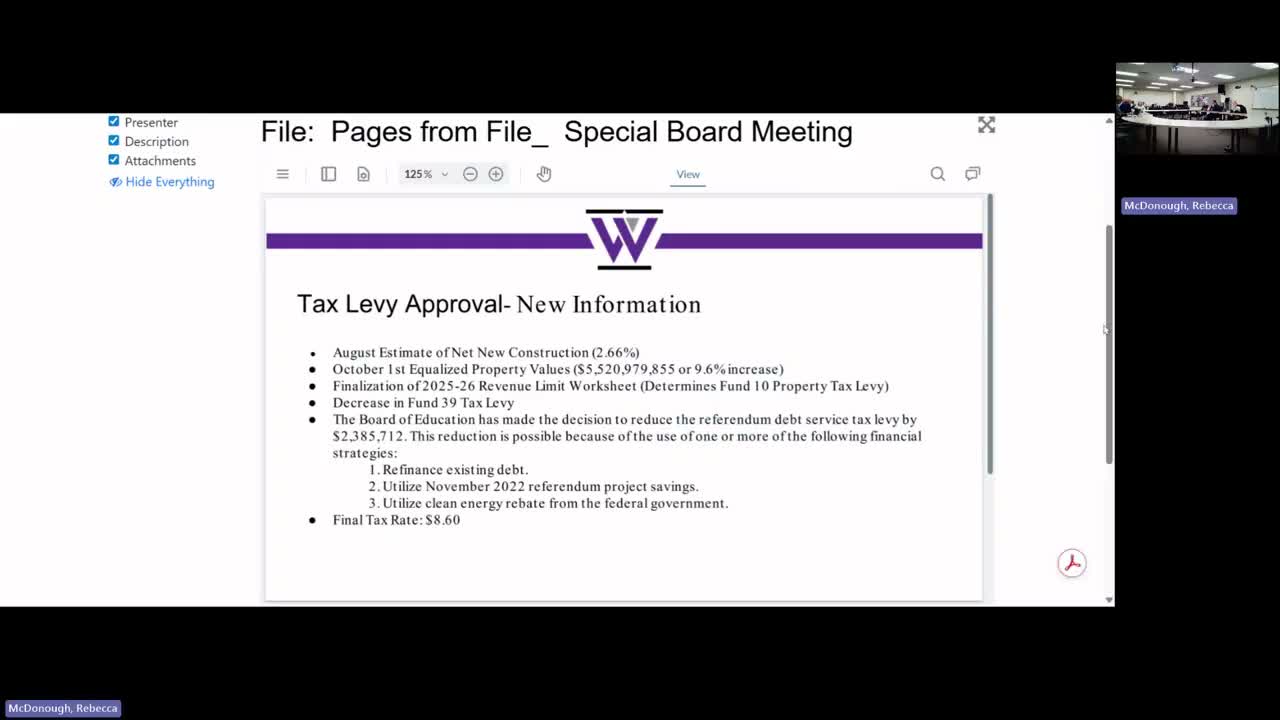
Summary
The Waunakee Community School District budget committee reviewed 2024–25 accomplishments, warned of uncertain state special‑education aid, and said the board’s Oct. 30 commitment to cut the referendum debt‑service levy by $2.3 million will be addressed in January with refinancing, referendum savings or federal clean‑energy rebates. The committee also moved to a 3‑year enrollment model for 2026–27.
The Waunakee Community School District budget committee met Dec. 1 to review budget accomplishments and to plan for 2026–27, including a board commitment to reduce the referendum debt‑service property tax levy by $2,300,000.
Speaker 3, a district administrator, summarized recent budget adjustments and ongoing risks. He said the district added $100,000 to contingency, $100,000 to transportation and $47,000 to legal in the recently adopted 2024–25 budget and had made allowances for a projected health‑insurance increase. He also flagged two major revenue risks outside the district’s control: state special‑education equalization aid and state high‑cost special‑education aid, both of which the district had budgeted conservatively because final state allocations and participation levels remain uncertain.
The committee revisited the board’s Oct. 30 decision to lower the referendum debt‑service levy by $2.3 million and discussed three options to implement that reduction: refinance existing debt (which would increase long‑term interest costs but avoid using referendum project savings), use November 2022 referendum project savings (which would constrain next‑year maintenance projects), or apply federal clean‑energy rebate funds (the most flexible option). Speaker 3 said the district’s financial advisors will present a debt‑service schedule in January that shows how those options would affect long‑term debt and what a potential high‑school capital referendum could look like.
On enrollment, the administration proposed moving from a five‑year projection model to a three‑year model for planning, arguing that the five‑year approach overestimated growth in 2024–25. The three‑year model projects 4,393 students for 2026–27 (an increase of 24), driven partly by an unusually small graduating class that reduces the gap between outgoing seniors and incoming kindergartners.
The staff reviewed school‑level staffing ratios and full‑time‑equivalent (FTE) conversions. The presentation showed decreased ratios at the middle school compared with earlier years and identified roughly four K–6 FTE that could be above what board policy requires if current enrollment trends hold. The administration warned that the small incoming kindergarten cohort will require a January decision from the board about open‑enrollment seats and whether to hold staffing at current levels or reduce sections.
Speaker 3 outlined the district’s planning assumptions for 2026–27: a 5% salary increase (a mix of CPI and step/compensation adjustments), a projected 5% health‑insurance cost increase (with employees likely absorbing part of the rise), and conservative assumptions for special‑education categorical aid (the district used 42% though the state budget shows 45%). He urged the committee to monitor state aid levels closely and to be prepared to adjust staffing or open‑enrollment capacity in January.
The committee did not take formal action on the levy options during the meeting; Speaker 3 said the district will bring detailed debt‑service schedules and enrollment scenarios to the January committee and board meetings so trustees can weigh the tradeoffs and pick a financing approach.
The committee adjourned after setting January as the month for follow‑up on open enrollment, staffing and long‑range financial plans.