
Trophy Club reviews parks master plan as council presses for clearer population data and priorities
Get AI-powered insights, summaries, and transcripts
Subscribe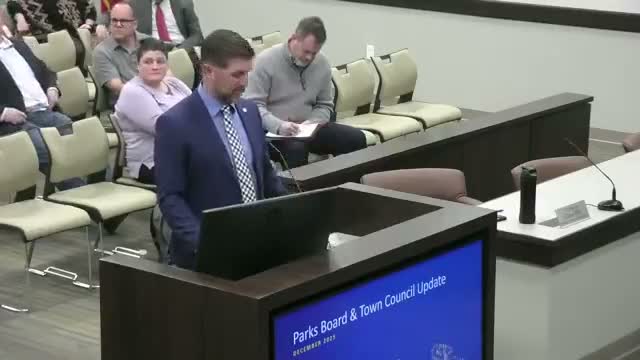
Summary
At a Dec. 8 workshop, consultants and staff presented a draft parks and trails master plan; council members asked that population projections be corrected or annotated, sought clearer phasing and costs, and scheduled follow-up work to refine near-term priorities.
Chase, the staff presenter, opened a Dec. 8 workshop for the Town of Trophy Club to review a 200+ page parks and trails master plan prepared with consultant Park Hill. Chase said the report combines a community survey, GIS mapping and facility inventories to guide park and trail improvements, programming and grant applications.
The meeting focused quickly on a disagreement over population inputs. Chase noted the plan includes multiple projection scenarios and cites national and state sources, including a Texas Water Development Board figure the presentation showed as 14,003 and 14,391. Several council members pressed that many of the plan—s charts instead use a higher median population (about 18,000) in calculating per-capita park needs. One council member said using the larger number could materially change conclusions and grant-application metrics, arguing: "If the realistic number is the water board number ... then let's update the document as the starting point." Chase responded that the plan—s project recommendations are based on current inventory and community survey input, and that staff would "take a look" and edit the population graphs if council consensus requires it.
The workshop also reviewed operational and design topics. Staff said Trophy Club Park had a 68% cost-recovery rate in 2024 (noting closures and staffing allocations affected the figure) and that 2025 revenues were recovering; the consultant emphasized that many park improvements are long-term and will be phased. Chase said the activity center concept would require a separate scoping and design process and that a long-term lease with the municipal utility district (MUD) would likely be needed before major investments.
Council members pressed for clearer phasing and more realistic implementation timelines and costs. Staff described a high-level cost-tier shorthand (under $50,000; $50k-$100k; $100k-$500k; over $500k) and said site-specific scopes would follow if projects are advanced. On medians and landscaping, staff recommended more native plantings and exploring smarter irrigation technology to cut water use; one council member cited a roughly 25% water-bill reduction from smart controls in a neighbouring HOA example.
Chase and staff agreed to revisit the plan—s population assumptions, suggested edits to demographic charts and additional workshops to prioritize actions before the council—s retreat. The presentation emphasized that the master plan is a high-level guide designed to support grant applications, inform the capital improvement program and structure future, more detailed design and budgeting steps.