Get Full Government Meeting Transcripts, Videos, & Alerts Forever!
Get email alerts on the Broadband topic
No spam. Unsubscribe anytime.
St. Tammany Parish uses $7M in ARPA funds to target last‑mile broadband gaps, aims to connect about 3,000 homes
Summary
St. Tammany Parish officials described a last‑mile grant strategy that uses roughly $7 million in ARPA funds to pay for home connections so private providers will build the middle mile, a plan officials say will directly connect about 3,000 homes and leverage service for many more.
St. Tammany Parish officials told the infrastructure committee that an ARPA‑funded last‑mile grant approach will pay for home connections so private providers will extend middle‑mile infrastructure, a strategy they say can address a roughly $72 million broadband coverage shortfall for about $7 million in local funds.
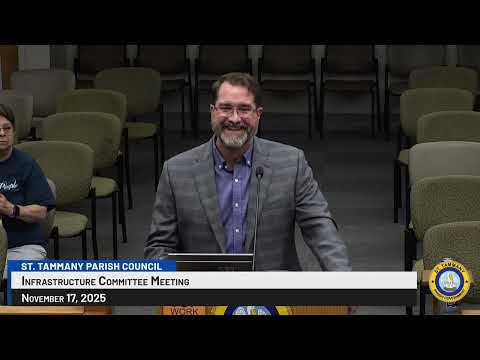
Grant, the parish technology director, said the parish commissioned an RFP and purchased speed‑test data to identify underserved and unserved pockets. "We identified it was about a $72,000,000 problem," he said, and then described narrowing investment to smaller, high‑need clusters that providers would then connect to the broader network.
The parish division of areas into seven so‑called "fiberhoods" follows a model used in other jurisdictions, Grant said. He described the program as a last‑mile grant that pays the incremental cost to connect homes: "What this does is this pays for the last mile from the neighborhood into the home." He said the parish had about $7 million to deploy and that paying for a concentrated set of houses would induce providers to build the middle mile that serves wider areas.
Grant said the parish paid for roughly 3,000 home connections at an average cost of about $2,800 per home, and pointed to a pilot in Folsom in which about 400 paid connections will end up benefiting roughly 1,200 addresses. He compared the parish figure to a state grant he called the "gumbo" grant, which he said was about $7,900 per home.
Officials reported that Phase 1 work was awarded and that Folsom has the first house connected following a recent ribbon cutting with AT&T. Grant said initial contracts are 24 months and that he expects the first phases to be completed "by this time next year." He also said the parish built a 10‑gig backbone capable of supplying symmetric multi‑gigabit service to addresses in the covered areas.
During questions, Grant told the committee that remaining gaps should be filled as federal/state BEAD funds are released, but he cautioned that BEAD disbursement is delayed: "They're being held up right now," he said, and that statewide targets put more complete coverage in the 2029 timeframe.
Committee members said the program is intended to benefit residents, students and local institutions. One council member asked whether schools, libraries and businesses at the fringe would gain service; Grant said several are already switching from charter or cable services to fiber.
No formal vote or binding action was taken because the clerk reported there was not a quorum at the start of the meeting. Officials credited Grant and parish staff for program design and implementation and said they would provide more precise parish‑wide coverage percentages on request.
Next steps identified by staff include finalizing remaining procurement phases, coordinating with state BEAD timelines as funds are released, and returning with exact parish‑wide percentage coverage figures and any outstanding households still unserved.