Get Full Government Meeting Transcripts, Videos, & Alerts Forever!
Get email alerts on the Budget Operating topic
No spam. Unsubscribe anytime.
St. Tammany Parish Council narrows 2026 operating budget, removes planned COLA and targets line-item cuts
Summary
The St. Tammany Parish Council approved a package of amendments to the proposed 2026 operating budget that removes merit and cost-of-living increases, shifts several line items and identifies roughly $1,000,000 in salary-related reductions; council members debated whether the net effect would materially increase general-fund cash because of cost-allocation accounting.
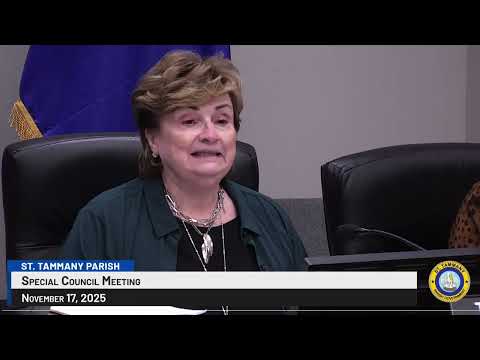
The St. Tammany Parish Council on a November meeting amended the proposed 2026 operating budget to remove planned merit and cost-of-living (COLA) increases and to impose a series of line-item reductions aimed at trimming expenses and addressing a projected 2027 general-fund shortfall.
Councilmember Cheryl Tanner introduced the amendment, saying the parish could face at least a $20 million general-fund deficit in 2027 and proposing removal of COLA/merit increases (about $1,000,000) and targeted cuts including $600,000 from Safe Haven, $356,000 to cover litigation not insured, $50,000 from council professional services, a $120,000 vehicle from the chief administrative officer’s budget, and the postponement or removal of several studies and capital purchases.
Annie Perkins, finance staff, told the council that because of cost-allocation accounting many of the proposed cuts would not translate dollar-for-dollar into additional general-fund cash. Perkins said some reductions would instead reduce allocations to other funds and that the net effect of a particular package under discussion was only about $1,900 to the general fund after allocations.
Councilmember Kelsman Phillips proposed adding a hiring freeze to the amendment; legal counsel cautioned that a hiring-freeze amendment might be non-germane to the pending amendment and explained the Robert’s Rules steps for amending an amendment. Parish President Cooper urged caution, saying five administration positions were listed in a late amendment and arguing those positions had generated or supported substantial external funding; he asked that the amendment be withdrawn for consultation.
Public commenters urged the council to examine fund balances and minimum-fund-balance policy. A speaker identified as Glenn said he had observed nearly $41 million in cash or equivalents across several restricted funds and urged lawful reallocation to cover criminal-justice shortfalls; finance staff and several council members replied that many of the funds cited are dedicated by statute or voter action and cannot be reallocated without legislative change or a public vote. Michael Henderson, another commenter, urged revising the minimum-fund-balance policy from one year to three months to free roughly $5.6 million for mandated funds.
After multiple rounds of amendments, procedural motions and roll-call votes, the council resolved several competing amendments. At one point the chamber approved an amendment-to-an-amendment, later voted to vacate that action under a motion to reconsider, and then reopened the floor to further amendments; the transcript records multiple roll-call tallies during the exchanges.
The council’s action changed specific appropriations and left several policy issues unresolved: staff made clear that some positions would lose funding and that departments affected might need to eliminate roles if salaries were no longer budgeted. Members asked staff to return with more precise cash-flow figures and the council discussed revisiting employee raises once actual insurance cost changes are known.
The council finished the operating-budget amendment work by approving the adjusted package and moving to introduce the related capital budget changes for consideration.
The council did not adopt a final, consolidated printed ordinance in the meeting; leaders said the ordinance would be introduced later with the approved amendments incorporated.