
Residents press board at public hearing on North Broadway land-use study
Get AI-powered insights, summaries, and transcripts
Subscribe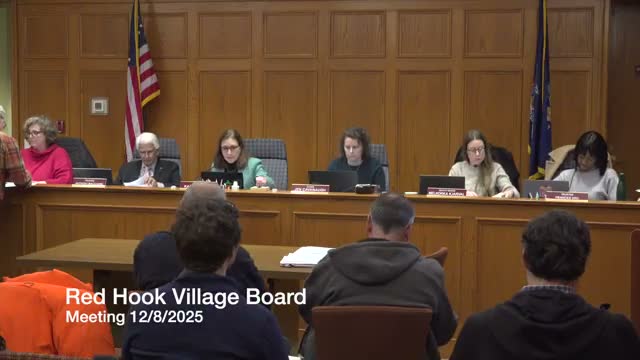
Summary
At a Dec. 8 public hearing, Red Hook residents raised concerns about traffic, historic character and the scale of housing proposed in the North Broadway land-use and zoning study; the consultant said the study will guide zoning changes but that any development will require site-plan review, traffic analyses and follow-up public hearings.
Bonnie, a land-use consultant retained by the village, presented the draft North Broadway land-use and zoning study at a Dec. 8 public hearing, outlining a study area that runs from a portion of the Buckingham property north to just below Cherry Street and explaining that the study began in September 2023.
The consultant said the study documents baseline conditions — demographics, housing typologies, existing land use, mobility and utilities — and identifies three zoning districts in the area: R20 (lower-density single-family), R10000 (higher-density single-family) and a General Business district intended to support pedestrian-oriented commercial uses and possible upper-floor residential units. She said the plan’s goals include allowing some mixed uses and modest infill while protecting the historic character of west-side residential neighborhoods. The consultant also described environmental and topographic constraints, noting a large, immovable hill and bedrock in the study area that will affect development feasibility.
The presentation explained that the study is intended as an addendum to the village’s comprehensive plan; any zoning amendments drafted to implement the study would require their own public hearings, legal review and, where required, state review. The consultant emphasized that site-plan review, planning-board review and design standards (the village pattern book) would apply to any development, and that larger proposals would need traffic analyses.
Residents who spoke at the hearing expressed a mix of support for more housing and strong concerns about local impacts. Nancy Van Diener, who said she lives two blocks from the area, urged protection of small historic houses along Graves and Cherry streets and asked for clarification about whether traffic routes would be shifted through CVS, Cherry or Graves and whether roads or parking lots would be widened. “I want people to be aware that the small homes along Graves and Cherry Street are part of the historic history of Red Hook,” she said.
Other speakers echoed safety and character concerns. Em Rose said she supports more housing in principle but warned against dense, cheaply constructed development that would erode village character and raised speeding on nearby streets. George Bateman, a long-time resident and former zoning-board member, questioned whether subsidized or low-income housing proposals would be sustainable for local infrastructure and schools and asked about unit sizes and long-term fiscal impacts. Several callers recommended traffic calming, sidewalks, crosswalks and preserving the village’s pedestrian orientation.
In response, the consultant reiterated that the study seeks to allow a measured mix of residential and nonresidential uses in targeted locations while protecting existing residential character on the west side of the corridor. She described an envisioned parallel access road behind existing commercial properties to reduce conflicting movements on Broadway, noted the potential for on-street parking and sidewalks where appropriate, and said the pattern book’s design guidance would be used to keep new buildings consistent with the village’s character.
The board closed the first of two public hearings and said it will gather public input and continue refining both the study and any zoning amendments in subsequent meetings. Another public hearing on the comprehensive-plan addendum and any draft zoning changes is expected before adoption.