Get Full Government Meeting Transcripts, Videos, & Alerts Forever!
Get email alerts on the Nutrient Management topic
No spam. Unsubscribe anytime.
Marathon County delays vote on manure, nutrient‑management ordinance after state flags buffer cost‑share requirement
Summary
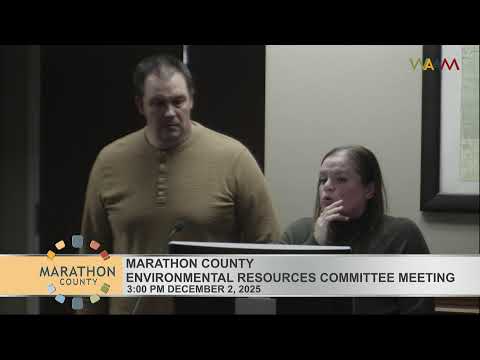
County staff recommended pausing a vote on a draft animal waste and cropland management ordinance after state review suggested the proposed 35‑foot stream buffers may trigger a requirement to offer cost share to every affected landowner; the committee agreed to delay until DATCP legal counsel provides options.
Marathon County officials paused final action on a draft animal waste and cropland management ordinance on Dec. 2 after state reviewers raised new questions about the ordinance's buffer provisions.
Kirsty Heidenreich, who introduced the topic to the Environmental Resources Committee, said Department of Agriculture, Trade and Consumer Protection (DATCP) legal counsel recently told county staff they may have to offer cost share if the ordinance requires a 35‑foot buffer adjacent to streams for all parcels. “The way the buffer part of our ordinance is laid out, we actually would have to offer cost share to folks that we are asking to put those buffers in,” Heidenreich said, describing the new guidance as a surprise to the county work group.
The recommendation to pause followed months of local stakeholder work and a staff white paper intended to document the scientific basis for the ordinance. Matt Repking, a county conservation analyst, described the package of proposed measures — including winter‑spreading limits, a winter spreading license option, and expanded nutrient‑management planning — as a compromise based on a year‑long work group effort. “We put that together in a paper that will hopefully also be a very helpful historical document for this county,” Repking said.
Why it matters: The buffer question directly affects the ordinance's cost and feasibility. If the county must offer cost share to every landowner where a new buffer is required, Heidenreich said, implementing the schematic as written could take decades under existing funding levels. She told the committee that the work group did not intend for universal cost share and that staff are exploring legal pathways with DATCP and the county's outside counsel.
Key points and debate: Staff framed the winter‑spreading restriction narrowly — targeted to pumpable liquid manure (about 12% solids or less) and intended mainly for farms with 300 animal units or more — while encouraging nutrient‑management plans through classes and incentives. Repking outlined the training and incentive structure: an initial plan fee of $260 with a $600 reimbursement (net incentive), refresher classes with reimbursements, a $100 incentive for turning in a completed plan, and soil‑sampling support.
Several supervisors pressed staff on fee design and equity for small farms. Committee members discussed whether a winter‑spreading license should be charged as a flat fee or on a per‑acre basis to reflect staff workload differences for creating SnapPlus maps and farm visits. “We liked the idea of perhaps the acreage format for pricing because it would be a lot cheaper for a smaller farm potentially,” Heidenreich said.
Public reaction: Three public commenters emphasized concern about the ordinance and related land‑use issues. Dean Beck said he feared a mandatory buffer would add burdensome rules on farms. Becky Tetrault, who runs Tansy Hill Farm wedding venue, urged protection of farmland and said she feared a nearby commercial solar lease would put her business at risk.
Next steps: Staff asked the committee to delay a final vote until the January meeting so DATCP legal counsel and the county's attorneys can confirm whether universal cost share is required and offer options for moving forward. Committee members agreed to the pause. The committee set its next meeting for Jan. 6, 2026, and staff said they will return with clarified options for the buffer provisions.