
Seaside TAC adds emergency briefing on AB 413; residents urge urgent outreach
Get AI-powered insights, summaries, and transcripts
Subscribe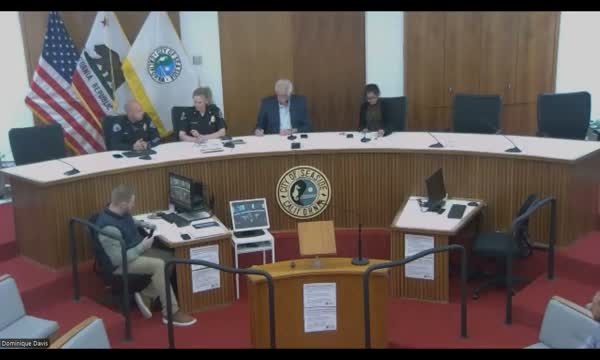
Summary
The Seaside Traffic Advisory Committee added an unscheduled presentation on California Assembly Bill 413 and heard from staff and residents about enforcement timelines, signage costs and a need for rapid public notification ahead of phased enforcement.
Adolfo Gonzalez, project manager in the city manager’s office, gave a short, unscheduled presentation to the Seaside Traffic Advisory Committee on Assembly Bill 413 — the state ‘intersection daylighting’ law that amends California Vehicle Code section 22500. The committee voted to add the presentation to the agenda by voice vote.
Gonzalez said AB 413 was approved by the governor on Oct. 10, 2023, and became effective Jan. 1, 2024. He summarized the law’s core change: vehicles may not park, stand or stop within 20 feet of marked or unmarked crosswalks (reduced to 15 feet where curb‑extensions or bulb‑outs exist) and local jurisdictions may adopt ordinances that adjust specifics. Gonzalez told the committee that, under the state rollout, warnings could be issued at certain unmarked locations in 2024, enforcement would broaden under a phased schedule, and that beginning in 2026 cited violations could be issued regardless of existing signage.
Committee members pressed staff on enforcement practicality and visibility. Gonzalez offered a cost example: about $500 for one regulatory sign (materials and labor) and roughly $2,000 to mark all approaches of a four‑leg intersection. He also said many intersections legally qualify as unmarked crosswalks under the vehicle code, meaning they are covered even without a painted red curb or posted sign.
Resident commenters welcomed the briefing and urged the city to notify residents quickly. Michelle Overmyer, a Seaside resident, said the item had not been on the agenda until the addition that night and asked the TAC to “submit a formal request to city council urging staff to take action on this and begin notifying the residents immediately.” Overmyer also suggested utility‑bill inserts and other non‑online outreach, and observed that the late addition raised Brown Act noticing concerns.
The committee asked staff to explore outreach options and coordinate with the public works director on implementation timing and methods. Staff said the item could be considered for inclusion in pavement projects and that county coordination might help share best practices for public notification and marking decisions.
The TAC did not take further formal action specifically adopting local signage rules that night; it added the item for presentation and discussed outreach and next steps.
The committee proceeded to other agenda items and scheduled further discussion and engineering work on related projects.