
Council probes BID collections as new business districts form; finance to modernize billing
Get AI-powered insights, summaries, and transcripts
Subscribe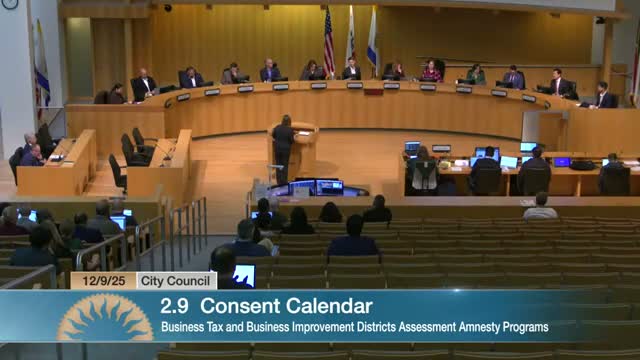
Summary
Council discussed Business Improvement District (BID) assessment collection problems and the role of amnesty programs; Finance said new system modernization and consolidated billing should improve collections for newer districts currently around 60% collected, while mature districts approach 90% collection.
Councilmember Mulcahy pulled item 2.9 and asked Finance Director Maria Oberg to explain why some Business Improvement Districts (BIDs) report lower collection rates and whether amnesty programs are necessary.
Maria Oberg said the city has over 96,000 registered businesses and that amnesty programs are used both to capture late payers and to bring unregistered businesses into the system. "We forgive not the base. We never forgive the base tax or the base assessment. We forgive penalties and interest," Oberg said, describing amnesty as a tool to secure the base assessment.
Oberg told council that newer BIDs created during a modernization period have lower collection rates ("around 60% to date") while more mature BIDs such as Japantown and downtown are "just shy of 90%". She said the finance team mails invoices on the 15th of the month prior to due date, follows up seven days after due date, and continues outreach and collections (including referrals to collection agencies).
Councilmembers asked whether the city can learn collection practices from other agencies and whether consolidated billing could reduce confusion; Oberg said the new business tax system and improved website functions are planned to reduce confusion and improve compliance next year.
Council accepted the consent calendar (which included the item) after discussion and public comment; vote passed unanimously.