Get Full Government Meeting Transcripts, Videos, & Alerts Forever!
Get email alerts on the Economic Development topic
No spam. Unsubscribe anytime.
Developers pitch two OPRA districts to Lansing council for small mixed‑use rehabs
Summary
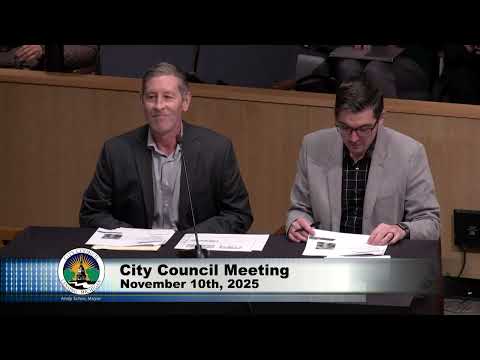
Developers seeking Obsolete Property Rehabilitation Act districts presented two small mixed‑use rehab proposals to the Lansing City Council on Nov. 10 — 414 Baker Street and 1204 South Washington Ave. Presenters said both buildings require substantial interior rebuilds and will be stabilized first; staff will refer the items to Development & Planning for the next steps.
Chris Klein of the Lansing Economic Development Corporation told the City Council on Nov. 10 that the two proposals before the council were requests to establish OPRA (Obsolete Property Rehabilitation Act) districts so property owners can later seek tax abatements to help finance full rehabilitation. "So, just basically what an OPRA is," Klein said, "that's an Obsolete Property Rehabilitation Act, and this provides a property exemption on commercial properties."
Maximilian Bortz, who said he has been a licensed builder for more than two decades, described his vision for 414 Baker Street: first‑floor low‑volume retail or office space and two two‑bed, two‑bath apartments above. Bortz said the building is “in a state of disrepair” and that the project would be a “100% rebuild from the ground up within the confines of the existing brick walls.” He told the council he plans one unit at about 80% of market rate and one at 100% of market rate, producing a modest amount of affordable housing in the corridor.
Council members pressed Bortz on parking and feasibility; he said a recorded easement offers parking behind the building. Councilmember Hussain and others praised the LEDC for using OPRA and other tools to support smaller, emerging developers rather than only well‑capitalized downtown projects. Klein emphasized that establishing a district is the first step and that a certificate — a separate application that grants the abatement — would come later and require state Tax Commission approval.
The second presentation was for 1204 South Washington Avenue in REO Town. Chris Rockwell and Emily Welinske said the two‑story, roughly 3,400‑square‑foot property is envisioned as a first‑floor art gallery/studio and a single residential unit upstairs. Rockwell said the upstairs currently lacks functioning electrical and plumbing, has a failing roof and requires hazardous‑material abatement (asbestos). Welinske described plans to operate the gallery and manage the residences.
Both applicants said they intend to stabilize the buildings and later apply for certificates to receive OPRA abatement. Council members and staff asked about environmental assessments, financing and whether demolition or major exterior restrictions would apply; staff reiterated that establishing a district does not itself grant an abatement and that further review and state approval are required. Both items were referred to the Development & Planning Committee for Nov. 12.