
Council denies Ascent Properties rezoning for large mixed‑use project on University City Boulevard
Get AI-powered insights, summaries, and transcripts
Subscribe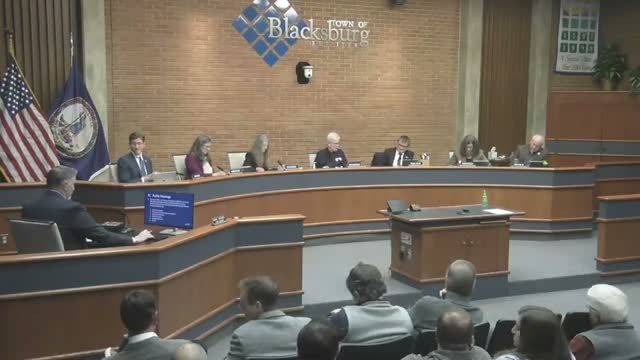
Summary
Council voted to deny Ordinance 2094, which would have rezoned ~4.6 acres on University City Boulevard to allow a six‑story mixed‑use student housing project with proffers that included up to 14% deed‑restricted affordable units and a $1,000,000 cash contribution. Neighbors and New River Valley service providers cited safety, traffic, and loss of commercial land.
Blacksburg Town Council on Monday voted to deny Ordinance 2094, a rezoning request for a mixed‑use redevelopment at 702–844 University City Boulevard that would have converted underutilized office and commercial parcels into a six‑story building with roughly 821 bedrooms.
Staff told council the application proposed a PRD (planned residential) with 821 bedrooms at approximately 177 bedrooms per acre, a 0.57 parking spaces per bedroom ratio, 30% open space (including rooftop terraces), and several proffers: a minimum of 14% affordable units deed‑restricted for at least 50 years, a $1,000,000 cash proffer to the town’s affordable housing fund, pedestrian and transit amenity improvements (including a covered bus shelter option), and extensive mitigation measures—sound attenuation, an 8‑foot privacy fence along the McBride Village edge, and a tree preservation/monitoring plan.
Josh Fassbiner, representing Ascent Property Company, said the project offers over $8.5 million in public benefits and commitments to partner with Habitat for Humanity on deeply affordable units and programs to connect transitional renters to homeownership. The applicant presented a parking study of comparable student properties and said the 0.57 ratio reflects observed demand.
During more than two hours of public comment, neighbors and nonprofit stakeholders opposed the rezoning, citing conflicts with the Comprehensive Plan’s commercial designation for UCB, pedestrian and vehicular safety at University City Boulevard/Prices Fork Road, potential strain on sewer and emergency services, and the project’s scale adjacent to single‑family homes in McBride Village. Habitat for Humanity of the New River Valley testified in support of the affordable housing commitments and the project’s partnership potential.
Council members split along lines similar to other housing debates: some argued the project’s affordability commitments and design changes justified approval; others said the project would set a precedent to erode commercial corridors and exacerbate current pedestrian safety risks before planned infrastructure improvements are in place. A motion to deny the rezoning carried on roll call.