Get Full Government Meeting Transcripts, Videos, & Alerts Forever!
Get email alerts on the Community Workforce Agreement topic
No spam. Unsubscribe anytime.
San Mateo council directs staff to negotiate community workforce agreement, starts five‑project pilot
Summary
The City of San Mateo council unanimously directed staff to negotiate a community workforce agreement (CWA) with labor representatives and pursue a project-specific pilot of five learning projects, with staff to return with data on bids, costs and apprenticeship outcomes.
The City of San Mateo City Council on Nov. 17 directed staff to negotiate a community workforce agreement (CWA) with the San Mateo County Building Construction Trades Council and to pilot the approach on a set of five city projects. The council’s direction was unanimous by voice and nods after an extended presentation by Public Works Director Matt Fabry and more than an hour of public comment.
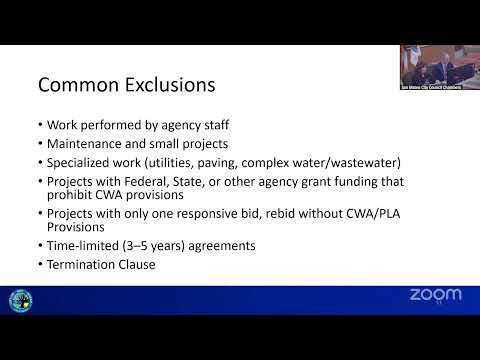
Fabry told the council staff had reviewed regional examples and the city’s bid history and proposed two decision paths for council: a project-specific pilot or a dollar-threshold approach. He summarized staff findings including 119 projects put to bid since 2019, 34 of them over $2,000,000, and flagged common issues in CWAs/PLAs such as potential “double benefits” payments by nonunion contractors and administrative burdens for city staff. He described the San Mateo County agreement recently adopted by supervisors (applying to projects at or above $3,000,000 starting in 2026, ratcheting down to $1,000,000 by 2029) and noted Watsonville recently rescinded a PLA after delivery issues.
Public comment was dominated by representatives of trade unions and apprentices who urged the council to adopt a CWA. Marcus Alvarez, an organizer for the Elevator Constructors Union, said, “The carpenters' leadership will claim they are being shut out, but the truth is they have chosen to exclude themselves.” In contrast, Eric Christen, executive director of the Coalition for Fair Employment and Construction, spoke remotely against discriminatory project labor agreements and asked, “What problem is this new bureaucracy and supposed solutions seeking to remedy?” Christen and other opponents warned CWAs can reduce bidder counts and exclude nonunion contractors.
Council members repeatedly said they wanted a data-driven, cautious approach. Councilmember Diaz Nash said she favored a project-specific pilot and asked staff to define measurable metrics for evaluating impacts on competition and apprenticeships. Staff said the pilot would let the city collect bid and price data and that, when a single responsive bid is received, staff would consider rebidding without the CWA as a mitigation measure. Staff also noted that some union data (certifications and availability) may exist at the county level and would need negotiation to obtain city-specific detail.
Several council members raised inclusion concerns and asked that the agreement allow carpenters and other trades to participate even if they are not members of the Building Trades Council. A Building Trades representative explained revised model language allows a construction trade union to sign on without formal BTC affiliation.
After discussion, staff summarized what it heard and the council provided direction: attempt to negotiate a CWA with the Building Trades group, pursue a project‑specific pilot of five learning projects (with flexibility on the final number and project selection), include termination/alternative provisions if a listed project does not proceed, prioritize data collection and apprenticeship targets, and allow participation by carpenters and other trades meeting the agreement’s requirements. The council instructed staff to return with findings from the pilot and any recommended changes.
The special meeting adjourned after the council’s direction.