San Mateo Planning Commission backs Cary School's 75-child early childhood center, urges traffic signage review
Loading...
Summary
The Planning Commission voted 4-0 on Dec. 9 to recommend the City Council approve Cary School's plan to build an early childhood education center at 2033 LaSalle Drive that would serve up to 75 preschool-aged children. Commissioners requested Public Works study timed no-parking signage and other traffic mitigations.
The San Mateo Planning Commission voted unanimously Dec. 9 to recommend the City Council approve Cary School's proposal to reclassify 2033 LaSalle Drive and permit a new early childhood education center to serve up to 75 children ages 2 to 5.
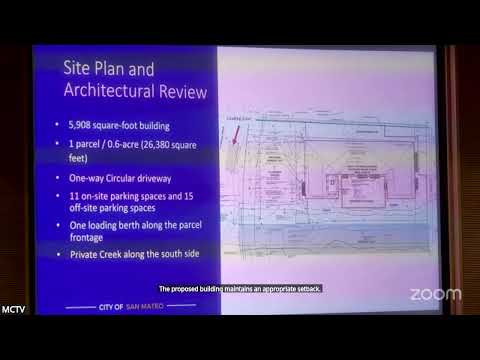
Staff presented the project as a rezoning from R1B to R1B/Q8 overlay with five entitlements: zoning reclassification, a code amendment to provide standards for private educational facilities, a special use permit, site-plan and architectural review, and site-development approval. Associate planner Simin Zakhovan told commissioners the project consists of a 5,908-square-foot single-story building, 11 on-site parking spaces and use of an off-site lot to meet the city's 23-space parking standard. Staff recommended the commission find the project exempt from further CEQA review under the staff-cited exemptions and forward a recommendation to council with conditions of approval.
Neely Norris, head of Cary School and the applicant, described the school's community role and said the project would expand preschool capacity and preserve full-day hours that working families need. "We hope to open this project in 2027," Norris said, and emphasized the school's commitment to financial aid: "That commitment is one of the many ways we're committed to diversity at our school." Norris said the project is intended to be donor-funded and that the school has maintained extensive neighborhood outreach, including a January 2025 meeting and multiple follow-ups.
Public commenters were split. Supporters, including parents and teachers, framed the project as a direct response to a documented childcare shortage in San Mateo County. "This project for us is a rare and much-needed solution," said Timothy Wong, a San Mateo resident and parent, who added that Cary would reserve fully subsidized spots. Other nearby residents urged caution, citing traffic, parking and tree-removal concerns. One speaker urged the commission to demand stronger evidence that the applicant's 50% carpooling assumption is realistic before final approval, saying such mitigation must be supported by substantial evidence in the record.
Staff and the applicant described a traffic and parking plan that relies on several measures: a 50% carpool reduction assumption informed by sibling overlap with the adjacent Cary campus, a pedestrian- and staff-monitored staggered drop-off schedule, three designated drop-off locations (Alameda De Las Pulgas, LaSalle circle and the project parking lot), and an existing off-site parking agreement for 15 spaces at 2000 Alameda. The traffic analysis estimated a net increase of 133 daily vehicle trips with roughly 28 net new AM peak trips and 27 PM peak trips; staff said the nearest intersection (20th and LaSalle) would operate at level of service C or better under the plan.
Commissioners praised the applicant's community engagement and design measures but also pressed for clarity on enforcement and monitoring of the traffic plan and on tree removals. Public Works staff said the city could examine signage and curb marking options and would pursue a maintenance agreement for access to a creek area on the site.
Commissioners approved a motion to recommend the City Council adopt the zoning reclassification and code amendment, find the project exempt from CEQA as stated in the staff report, and adopt a resolution approving the planning application with the listed findings and conditions. The motion included an additional request that the City Council ask Public Works to study potential timed no-parking signage and other measures to help traffic flow; the Planning Commission passed the motion by roll call, 4-0 (Vice Chair Clafeter, Commissioner Bush, Chair Patel and Commissioner Williams voting yes).
What comes next: Because the Planning Commission is a recommending body for the Q8 overlay and zoning reclassification, the item will go to the City Council for final action; the appeal window for the commission's decision is ten calendar days after council action. Staff indicated the project will go to council in early January.
The planning record for the application includes the project plans, the traffic and parking memorandum, neighborhood meeting notes, and comment letters received by staff.