
Santa Clara launches stadium subcommittee as residents press for parking, closures and Super Bowl plans
Get AI-powered insights, summaries, and transcripts
Subscribe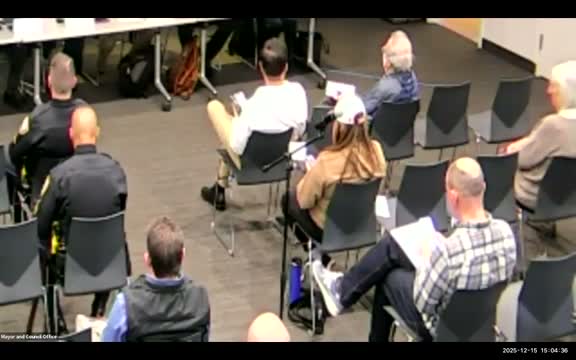
Summary
The City of Santa Clara convened its first Stadium Neighborhood Relations ad hoc subcommittee to gather resident input on parking spillover, noise, litter and public-safety impacts around Levi's Stadium and to preview planned road and trail closures for Super Bowl LX and FIFA World Cup matches. Staff described limits to current enforcement and options for a new residential parking program and LPR technology.
The City of Santa Clara held the inaugural Stadium Neighborhood Relations ad hoc subcommittee meeting to hear resident complaints about parking spillover, noise and litter from stadium events and to outline operational plans for Super Bowl LX and upcoming FIFA World Cup matches.
Council Member Albert Gonzales was nominated and approved as chair and Council Member Karen Hardy as vice chair. City Manager Jovan Grogan said the subcommittee is a temporary forum to improve two-way communication with residents and businesses "to provide updates on a once-in-a-lifetime opportunity of hosting these two global events in 2026." Grogan said staff will return with a detailed presentation of stadium finances and the stadium authority at a future meeting.
Residents from neighborhoods closest to Levi's Stadium — including Ferry Glen, Mission Park, Rivermark and Lakeshore — described recurring problems during events: parked cars taking neighborhood spaces, illegal ride-share drop-offs, large parties, public intoxication and litter. "I'm really concerned about things that are happening there and looking forward to some solutions or mitigations," said resident Helen Narciso. Multiple speakers said earlier promises made during Measure J and in later outreach had not been implemented.
Police Chief Corey Morgan framed the department's priorities as public safety, crowd management and mobility, and described how large events are managed under the National Incident Management System and an Incident Command System. Chief Morgan noted the department has been operating stadium events for 12 years and wants the subcommittee to be "action oriented" with practical recommendations. He said conflict over neighborhood access is primarily a policy issue: the neighborhood "stickers" historically distributed to residents were "well intentioned" but enforcement authority was never codified, and "there's no legal authority for us to enforce those stickers," he said.
City staff and SPD outlined options for controlling parking spillover. The city currently has an elected Residential Parking Program (RPP) that requires a 50% plus 1 voter threshold to implement neighborhood-only restrictions and issues a maximum of two permits per address. Grogan and staff described an RFP to procure a new, user-friendly system that uses license-plate recognition, online registration and event‑day rules; such a system could support event-day restrictions, visitor passes and dynamic enforcement if the council elects to authorize it or if neighborhoods vote to adopt it.
SPD also presented 2021–2025 hotline data from the city’s 2280 line (initiated in 2019): across 81 events staff tracked 97 calls, with noise (33 calls), illegal vending (24) and parking (19) the largest complaint categories. The department said it compiles post-event summaries and after-action reviews and is using data to guide improvements.
Staff previewed Super Bowl permit submittals and a phased plan for road and trail closures beginning as early as January. Phase 1 includes closure of the Stars and Stripes connector and some trail heads to support build-out and heavy‑vehicle staging; the NFL has secured a temporary satellite train-station lot at Tasman East for ADA shuttles and satellite parking. Phase 2 would expand closures and detours (including a closure window for the Santa Clara Creek Trail) and run through the Super Bowl operational window in early February. Staff cautioned that high‑security events have broader perimeters and that closures require trade-offs for commuters and alternate users.
The city also described a temporary Special Event Zone ordinance that would be activated Feb. 1–10, 2026, inside which the city would pause certain sidewalk‑vending permits, require permits for temporary structures in commercial areas and focus outreach and education before targeted enforcement. Code enforcement will lead enforcement with police support when necessary.
Residents recommended local operational fixes, such as closing a specific emergency-access walkway (Wilcox and Giannara) to deter walking shortcuts from adjacent neighborhoods; participants said the path had been closed during a prior Super Bowl and urged staff to study reopening that temporary closure for event days. Staff said they will evaluate closures, noting they must balance security needs with commuter, bike and Capitol Corridor access.
The subcommittee closed with two procedural items: nomination and voice vote approval of Albert Gonzales as chair (nominated by City Manager Jovan Grogan, seconded by Council Member Suds Jane) and nomination and approval of Karen Hardy as vice chair. Staff said next meetings will include deeper dives on parking program options, stadium financials and targeted topics raised by residents such as trails, ride‑share, litter and communications.
The chair adjourned the meeting at 5:02 p.m.