
Apex planning board approves Viridia amendments to accommodate planned children's hospital, removes planned rail spur
Get AI-powered insights, summaries, and transcripts
Subscribe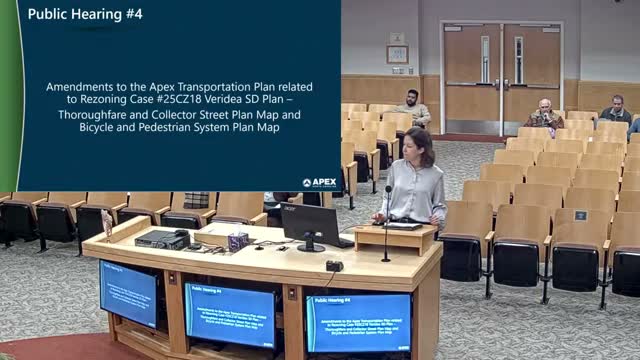
Summary
The board approved a package of Viridia amendments Dec. 8 that revise thoroughfare and bike/ped maps, remove a planned commuter rail spur in favor of a bus transit center, adjust SD plan standards for a hospital campus, and amend environmental standards including new EV-capability options and a developer‑built 25,000 sq. ft. recreation center.
The Apex Planning Board voted Dec. 8 to approve a package of amendments for the Viridia mixed‑use area intended to accommodate a proposed North Carolina Children’s Hospital campus, revise transportation and bike/ped designs, and update the development’s environmental standards.
Shannon Cox, the town’s long‑range planning manager, told the board that staff recommends realigning several future thoroughfares to improve sight distance and to shift street connections slightly to reduce stream crossings. A more consequential change was the removal of a planned commuter rail spur and the rail‑based transit center within Viridia after the Capital Area Metropolitan Planning Organization (CAMPO) identified the link as unlikely to receive federal or regional funding by 2035; staff said CAMPO provided a high‑level cost estimate of about $63,000,000 for such a rail project.
"We are recommending that we add a bus transit center in this location which is much closer to the 55 Corridor and adjacent to where the Wake Technical Community College is proposed," Shannon Cox said, noting support from GoTriangle and town departments.
Amanda and other planning staff summarized Sustainable Development (SD) plan amendments that create specific exemptions and flexibilities for a hospital campus — including modifications to grid/block standards, energy efficiency goals and certain design standards — to allow the site to function as a campus rather than a dense urban block pattern. The applicant and developer representatives said RXR Realty has been negotiating the project and that North Carolina Children’s Hospital is under contract for the property, with a potential land closing anticipated early next year.
Jason Barron, representing MorningStar Law Group, and Joe Graziosi of RXR described developer commitments including reserving land for a bus transit center, providing four bus stops near the hospital campus, and constructing a 25,000-square-foot programmable indoor recreation center (RXR has agreed to provide the land and build the facility while the town designs it; the details will be worked out in a developer agreement). Simon George of North Carolina Children’s said the hospital team is finalizing architects and construction management and expects to break ground in the near future if the land closing proceeds.
The board approved the related items — bike/ped amendments, transit plan amendments (removing the internal rail spur and adding bus‑transit planning), the SD plan amendments for the hospital campus, and the associated Environmental Enhancement Plan (EEP) changes — each by voice vote. Board members praised the coordination between staff, the developer and other agencies and noted transportation, recreation and school‑capacity implications as items to monitor.
EEP changes include revised EV parking requirements for Viridia: for hospital campus uses staff proposed EV charging at 0.3% of required parking spaces and EV‑ready at 1.5% (staff said thousands of parking spaces will be built for hospital uses, so absolute counts remain substantial); multifamily standards shift EV charging/EV‑ready percentages to favor EV‑ready infrastructure; and the plan introduces an "EV capable" option (raceway/conduit only) as an alternative to full EV‑ready installations in some circumstances. Staff said the changes reflect site scale, cost considerations, and evolving vehicle technology.
The planning board forwarded the approvals as recommendations; staff noted that project‑specific details such as construction timing and developer agreements will be resolved with the town council and through subsequent permits and agreements.