Get Full Government Meeting Transcripts, Videos, & Alerts Forever!
Get email alerts on the Outdoor Dining Legislation topic
No spam. Unsubscribe anytime.
Manhattan CB2 working group flags ADA and enforcement gaps as City Council readies outdoor-dining bills
Summary
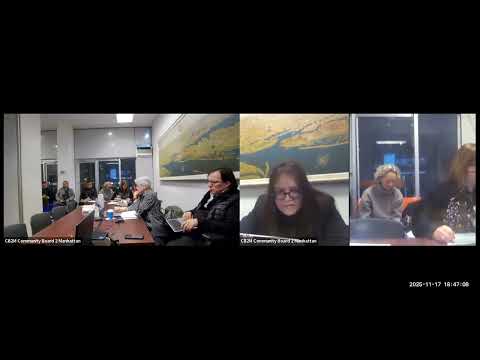
Manhattan Community Board 2’s outdoor-dining working group urged clearer ADA guidance and better DOT referral accuracy after discussing several City Council bills that would expand roadway and sidewalk cafe access, move program management between agencies, and remove revocable-consent requirements.
Valerie Dela Rosa, chair of Manhattan Community Board 2’s outdoor dining working group, told members that three City Council “intro” bills are scheduled for a joint committee hearing on Monday, Nov. 24, and two more have been introduced since. The measures would expand roadway and sidewalk-cafe access, allow new types of businesses to apply, require DOT rulemaking for winter (snow) operations, and propose moving program oversight from DOT to the Department of Consumer and Worker Protection.
Why it matters: The bills would rewrite how outdoor seating is permitted in New York City — changing who issues licenses, how much pedestrian space must be preserved, and whether revocable-consent signatures from property owners remain part of the application. The working group said those changes could materially affect Lower Manhattan’s narrow sidewalks and heavily used streets.
The committee identified several recurring problems in DOT’s referral packets that it wants to raise at the Council hearing: site plans that misstate sidewalk widths and tree-bed or manhole locations; missing checkboxes for required items such as furnishings and awnings; and inconsistent placement of service aisles and Siamese (FDNY) connections. “These proposals will require extensive DOT rulemaking coordination, snow‑clearing liability clarification and firm ADA guidance,” a board member said during the discussion.
The working group asked staff to prepare short, focused testimony for the Council hearing calling for: 1) explicit ADA and clear-path rules (including how to measure clearance around tree pits, ramps and street furniture); 2) a DOT referral‑quality checklist so community boards receive accurate site plans; and 3) careful geographic carve‑outs rather than universal one‑size‑fits‑all clearances for every block. Members proposed a one‑page board position and asked to split testimony across several speakers at the hearing.
What’s next: The joint hearing is scheduled for 10 a.m. Monday, Nov. 24 (subject to Council scheduling changes). The working group will draft testimony on the bills — notably Intro.1421 (expand roadway access and remove seasonal restrictions), Intro.1444 (set a maximum pedestrian-path requirement), Intro.1446 (application portal and in-person assistance), Intro.1440 (transfer program management to the Department of Consumer and Worker Protection), and a separate measure that would repeal the charter requirement for revocable consent so DOT would issue licenses directly. The committee urged early engagement so the board’s concerns about ADA standards, measurement methods and enforcement are on the record.
Members emphasized that any transfer of authority or expansion of geography should include clearer measurements and enforcement pathways so operators and enforcement agencies have a consistent standard to follow.