
Council approves University Boulevard corridor plan and related zoning amendments with housing protections added
Get AI-powered insights, summaries, and transcripts
Subscribe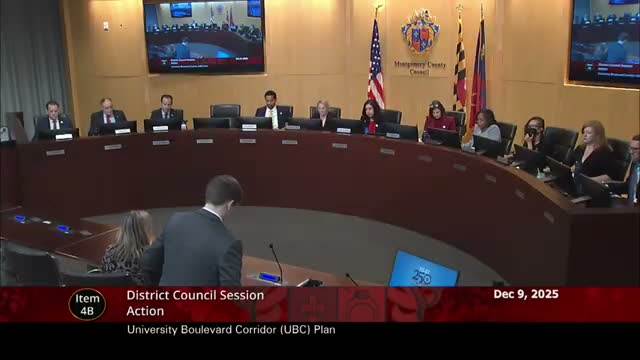
Summary
The County Council approved the University Boulevard corridor plan with an amendment to require five-year reporting on affordable housing production and passed two zoning text amendments to implement the plan, including a 15% MPDU requirement inside the plan area.
The Montgomery County Council approved the final University Boulevard corridor plan and two implementing zoning text amendments after debate over displacement protections and affordable-housing metrics.
Planning staff explained that the adopted plan includes an addendum fixing capital-improvement-table entries and codifies several standards. Councilmember Will Giordano said the plan must address displacement protections and affordable housing, and moved to oppose the plan as initially drafted, saying it lacked sufficient anti-displacement measures. Councilmember Lorraine Sells proposed and the council adopted an amendment to add transparency and five-year reporting on affordable and market-rate housing production tied to the plan’s racial equity and social-justice metrics.
Planning staff noted implementation provisions including a 15% MPDU requirement in the plan area—2.5 percentage points above the standard county rate—and language to strive for no net loss of affordable housing. The council then voted on the corridor plan as amended; the president counted hands and announced the motion carried. The transcript records seven in favor and three opposed on the final corridor-plan vote.
The council also considered Zoning Text Amendment (ZTA) 25-12 to enact the University Boulevard overlay and ZTA 25-13 omnibus revisions for clarifications and corrections. The council recorded a roll-call vote that approved ZTA 25-12 (vote recorded in the transcript as 9 to 1) and unanimously passed ZTA 25-13. Staff cautioned that forecasting exact unit production is difficult because redevelopment outcomes are uncertain; planners said the plan prioritizes public benefits such as larger family-sized units and additional affordable housing through MPDUs and workforce-housing requirements.
Councilmembers stressed the need to pair plan approvals with implementation steps—pedestrian safety fixes and coordination with DOT and housing agencies were cited as immediate priorities.