
MERS briefing: Grand Haven’s closed pension divisions 66% funded, staff urged to watch assumptions
Get AI-powered insights, summaries, and transcripts
Subscribe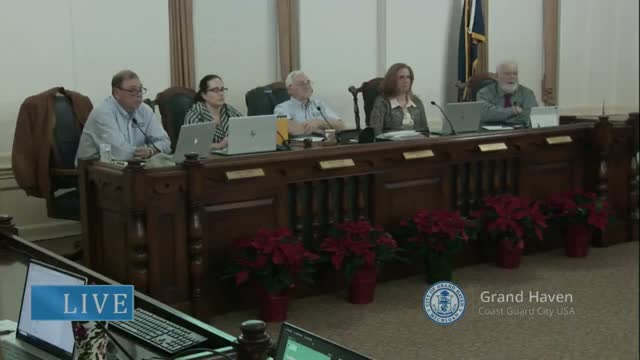
Summary
MERS told Grand Haven council the city’s defined-benefit plan was 66% funded as of Dec. 31, 2024, explained smoothing and amortization practices, and recommended attention to investment-return assumptions and continued voluntary surplus contributions.
At a Dec. 15 work session, Veronica Labar, regional manager for MERS of Michigan, briefed Grand Haven City Council on the city’s defined-benefit retirement plan and the actuarial mechanics that set employer contribution requirements.
Labar said the city’s plan has six divisions, most of them closed to new employees, and that the plan’s 2024 annual actuarial valuation shows a funded level of 66% (down from 67% the previous year). She noted key assumptions driving contribution calculations: a MERS standard wage-inflation assumption of 3% and a current assumed rate of return of 6.93%. "Our current assumed rate of return for our plan is 6.93%," she said.
Labar explained two common actuarial practices: smoothing (using an actuarial value of assets to spread market gains or losses over five years) and layered amortization (open plans amortized over 15 years; closed divisions move toward a 10-year amortization). She told the council that the 2022 market losses are still being smoothed into the city’s contribution calculations and that a dedicated-gains policy can reduce the effect of lowering the assumed rate of return.
The presentation highlighted the city’s use of a surplus division to accelerate funding: the council has made voluntary contributions (noted as $500,000 in 2023) into a surplus "S1" division that raises the plan’s overall funded percentage without reducing the actuarially computed employer bill. Labar said that as the amortization period for closed divisions shortens year by year, the projection to full funding will also shorten.
Council members asked several technical questions about amortization shifts and the practical impact of surplus contributions; Labar offered to return with additional detail and noted the next full actuarial valuation will be available on June 30, 2026. The session was paused for the regular meeting and council held additional discussion later in the evening.