Get Full Government Meeting Transcripts, Videos, & Alerts Forever!
Get email alerts on the Zoning Temporary Shelters topic
No spam. Unsubscribe anytime.
Athens council advances zoning change allowing temporary shelters in R‑3 and B‑3; amendment that would add limits fails to meet required threshold
Summary
Council read an ordinance to allow temporary housing shelters as a conditionally permitted use in R‑3 and B‑3 zones and heard public concern. Member Thomas proposed amendments (licensed‑agency supervision, MOU, caps of six units per site and five sites citywide, no fees) but the change that departed from the planning commission did not meet the statutory three‑fourths threshold and therefore was not adopted at first reading.
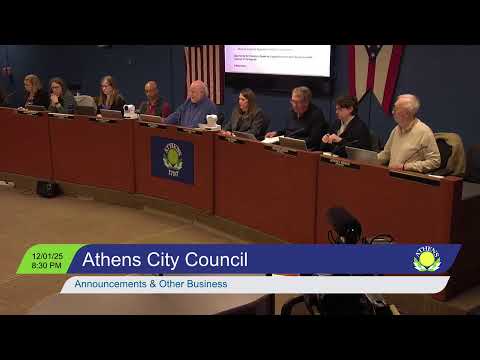
Council members on Dec. 1 read an ordinance that would allow temporary housing shelters as a conditionally permitted use in R‑3 (multifamily residential) and B‑3 (general business) zones, and opened discussion about how to regulate those shelters.
Council member Swank read the planning commission recommendation, which describes temporary shelters as housing structures not affixed to property and without kitchen or bathroom facilities and requires “1 sink and 1 toilet available for use within 200 feet for every 3 temporary housing shelter units” and annual reapproval by the service safety director.
During public comment, Jack Stauffer of Elmwood urged council to “drop this tonight” and said the city should provide “real shelter inside a building of some type” rather than moving people to tents; he told council that, in a November 17 conversation, the police chief described a rise in vehicle break‑ins that the commenter “suspected homeless” individuals were involved in. Stauffer said moving encampments onto private property would hurt nearby residents’ comfort and safety.
Member Thomas proposed a set of amendments intended to address those concerns. As she summarized them, “said shelters must be under the supervision and care of a licensed local health and welfare agency or churches and other incorporated faith based organizations and state licensed public welfare organizations,” and “an approved agency must have an MOU agreement in place with the service safety director defining operational terms governing the location.” She also proposed a maximum of six shelter units per applicant location, a maximum of five locations permitted at one time within city limits, and a prohibition on collecting fees in exchange for use of the shelters.
Supporters in the audience urged council to allow the amended language to proceed so the public could review the changes during the two remaining readings. Council discussion included administration and mayoral concerns about rolling the rule out citywide before seeing how the Gathering Place and Sunset Motel projects affect capacity and demand.
The law director advised council that, under the city’s zoning rules, any amendment that “differs or departs from the recommendations submitted by the [planning] commission” must be approved by not less than three‑fourths of the full membership of council (six of seven members). The proposed amendments did not reach that legal threshold, so the ordinance stands as presented by the planning commission and was read for the first time without the Thomas amendments being adopted.
The council previously voted in committee to move the planning commission recommendation out of committee so it could be considered by the full council at first reading. The ordinance will return for the next readings where council may vote on final passage or consider additional changes in accordance with the law director’s guidance.
What happens next: Council will take further action during scheduled upcoming meetings; if the body wishes to adopt amendments that depart from the planning commission, it must secure the statutory three‑fourths vote.