
Athens council approves zoning change to allow temporary shelters in R‑3 and B‑3 zones
Get AI-powered insights, summaries, and transcripts
Subscribe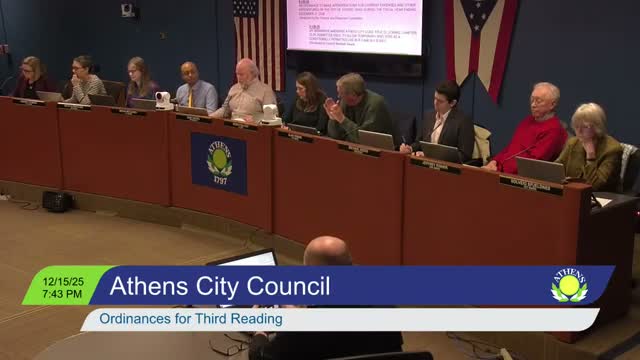
Summary
On Dec. 15, Athens City Council approved an ordinance making temporary housing shelters a conditionally permitted use in R‑3 and B‑3 zones, with an approval route that requires sign‑off by the Safety Service Director and the Board of Zoning Appeals and annual reapproval.
Athens City Council on Dec. 15 approved Ordinance 1‑39‑25 to allow temporary housing shelters as a conditionally permitted use in R‑3 and B‑3 zoning districts, a measure proponents said will provide additional tools to address winter shelter needs while opponents warned of legal and community risks.
The ordinance specifies that temporary housing units “are not affixed to the property and do not contain kitchen or bathroom facilities,” requires that “1 sink and 1 toilet must be available for use within 200 feet for every 3 temporary housing shelter units,” and directs that approval by the Safety Service Director must precede consideration by the Board of Zoning Appeals (BZA). It also requires annual reapproval by the Safety Service Director.
Proponents, including the ordinance sponsor Member Swank, argued the change creates guarded flexibility. “We can do better than temporary structures… there are better places than along our main thoroughfares,” Swank said while emphasizing the need for “appropriate housing in appropriate places with appropriate supervision.” Member Thomas said the measure was a “proactive” multi‑tier approach that would let the city respond quickly during cold spells.
Opponents pressed for clearer standards and questioned whether delegating initial approval to the Safety Service Director and then the BZA creates differential treatment that could invite legal challenge. Attorney and public commenter Judge Alan Goldsberry warned the council about spot‑zoning concerns and urged clearer written standards; several speakers from the public asked for explicit approval criteria and limits on duration and capacity.
The law director told council the process differs from how the Gathering Place was approved and acknowledged the approval route is “different,” saying he could not predict whether the difference would prompt litigation. Multiple members asked whether BZA review and the safety director’s sign‑off provide sufficient guardrails; proponents said the BZA’s quasi‑judicial process and public hearings would allow case‑by‑case conditions tailored to each proposed site.
Public testimony spanned a range of views. Ginger Schmullenberg, who said she was working with the Gathering Place on a Conestoga Hut pilot and Medicaid reinvestment funds, urged passage so service providers could use funding to secure sites. Ken Lankes, who spoke in favor of rapid action, said, “People need help now.” Other residents urged patience until the Sunset Motel renovation proceeds and called for stronger written standards before broadening zoning.
After an attempt by a council member to table the ordinance failed for lack of a second, council held a voice vote. The motion carried with two recorded nays. The ordinance now permits temporary shelters in R‑3 and B‑3 zones subject to the approval and annual review process outlined in the ordinance.
Council members and the public framed the change as a practical tool to address homelessness in severe weather while underscoring open questions about the specific standards the Safety Service Director or BZA will apply and how frequently sites will be reapproved.