
Lakewood board reads new cell‑phone policy to comply with House Bill 96; policy would restrict phones during instruction
Get AI-powered insights, summaries, and transcripts
Subscribe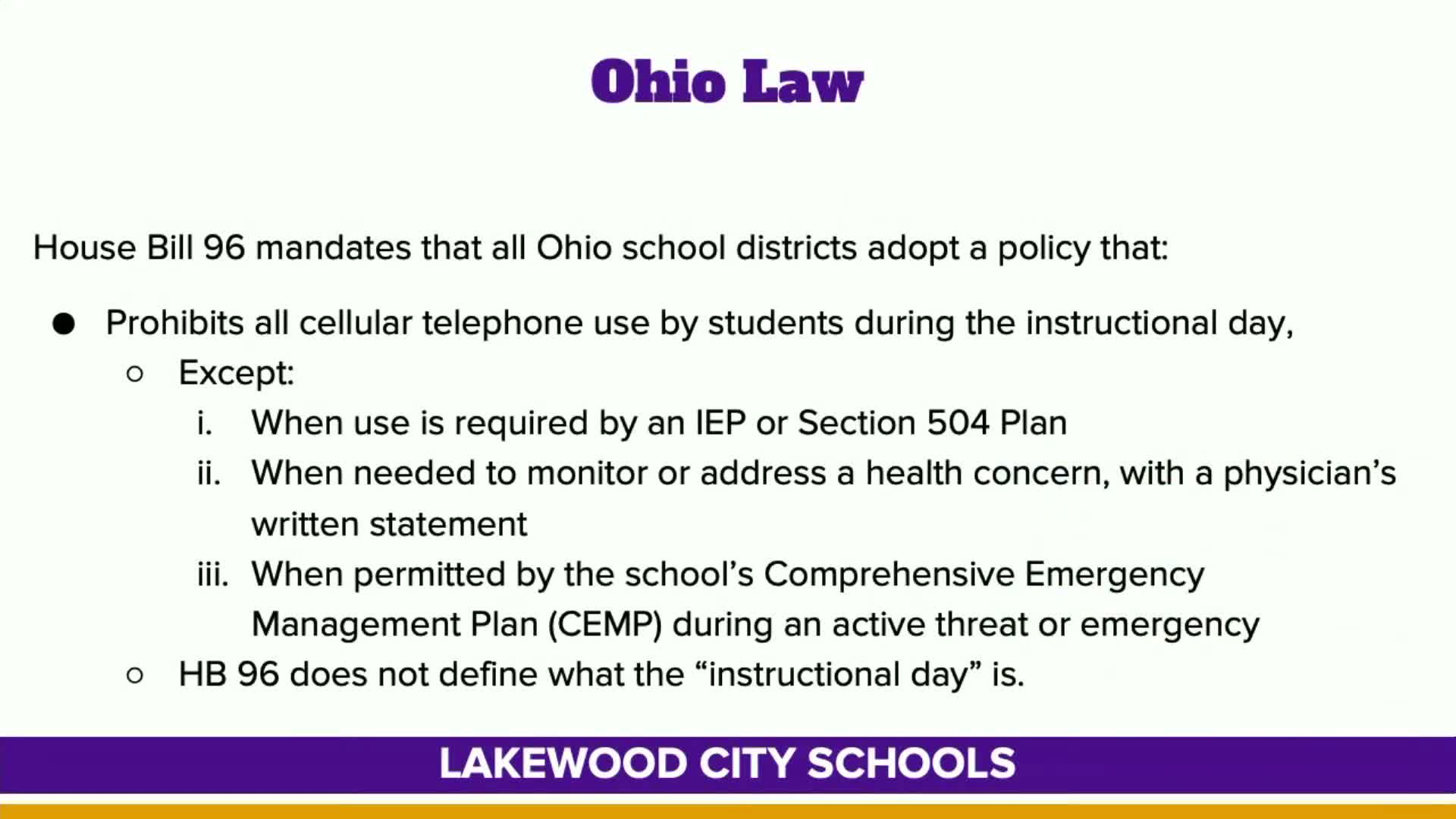
Summary
District staff proposed a policy to comply with House Bill 96 requiring districts to ban cell‑phone use during the instructional day except for IEP/504 accommodations, health monitoring or emergency‑plan permissions; the draft sets no‑phone rules for elementary, locker requirements for middle schools and zone rules for high school classrooms.
The Lakewood City Board of Education on Dec. 1 heard the first reading of a revised student cell‑phone policy meant to implement House Bill 96, which requires districts to adopt rules by Jan. 1 that generally prohibit phones during the instructional day.
District staff summarized exceptions the law allows, saying the ban would not apply when phone use is required by an IEP or 504 plan, when phones are needed to monitor or address a health concern, or when allowed by a school’s emergency operations plan. "House bill 96 mandates all districts must adopt a policy by January 1 that outlaws, cell phones during the instructional day with the exception of when use is required, by an IEP or 504, when needed to monitor or address a health concern, when permitted by the school's comprehensive emergency management plan," the staff presenter stated.
Under the draft policy staff recommended to the board, elementary students would not bring phones to school; middle‑school students would store phones in lockers during the school day; and high school students would have zone‑based flexibility with classrooms designated as no‑phone zones and non‑instructional areas (hallways, lunchroom, passing time) permitted for limited use. Dr. Palumbo told the board the proposal is designed to be age‑appropriate and to give high‑school students some responsibility over phone use while minimizing instructional disruptions.
Board members probed how the district will interpret "instructional day" because the statute does not define that term. Staff said Ohio Department of Education guidance suggests the instructional day could run from arrival to dismissal but that guidance is not codified in statute; the staff recommended framing local practice by level and retaining flexibility should state definitions change.
On enforcement, staff described a graded response: a principal or teacher will address single incidents; repeated violations would prompt parent contact and could lead to suspension for high‑school students only in recurring cases tied to behavior policies. "If it becomes a repetitive thing, the parent would be contacted," a district presenter said, noting suspension is a last resort for repeated high‑school violations but not an expulsion‑level penalty.
A board member asked about a struck‑through reference in the harassment/cyberbullying list that appeared to remove "sexual orientation" and "transgender" language. Staff responded the removal is intended to remove redundancy because those protections are covered elsewhere in the policy set provided by the board’s Neola consultant, and affirmed affected students remain protected.
The board did not vote on the policy at the meeting; staff said the reading is required ahead of a Jan. 1 effective date and additional discussion and a final vote will follow once the board completes its review. The district plans to continue building‑level conversations and community messaging to clarify how the rules will operate in practice.