
Committee examines Cactus flags, expedited hearings and whether law allows license revocation for 'incompetence'
Get AI-powered insights, summaries, and transcripts
Subscribe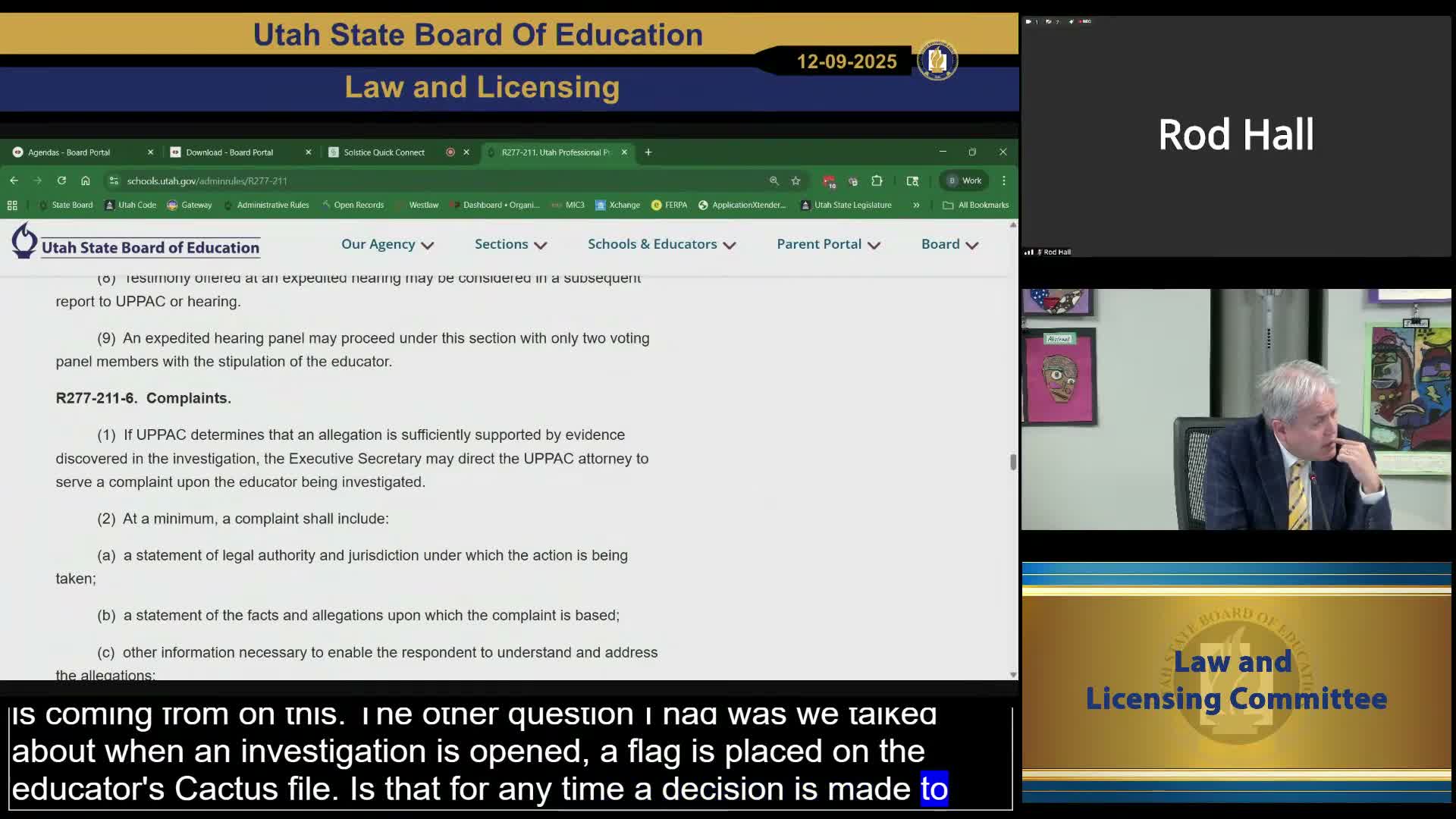
Summary
Committee members sought clarity on how Cactus file flags are used, when expedited hearings are offered and whether the licensing statute’s language about 'immoral, unprofessional, or incompetent' conduct could be applied to remove or refuse educator licenses.
Committee discussion turned to the practical consequences of opening investigations and the statute governing licensing.
Director Ben Rasmussen told the committee that a flag is placed on an educator's Cactus file when an investigation is opened, a practice he said has been in place "as long as I've been here." He said expedited hearings are offered for nondisputed, generally minor cases and typically do not result in a Cactus flag; expedited hearings are scheduled quickly and often resolve in "2 or 3 months" compared with a full investigative process that can take closer to a year.
Members asked whether offering expedited hearings without flags creates an incentive for educators to accept the expedited process to avoid a flag; Rasmussen said the expedited option is offered for the benefit of the educator and for timeliness, and that if an educator declines expedited review staff will explain what happens next, including that a flag would be placed if a full investigation is opened.
The committee also raised whether state statute gives the board authority to refuse to issue or to strip licenses for behavior categorized as "immoral, unprofessional, or incompetent." Rasmussen said the statute (53E-6-603) permits refusing to issue a license and noted that one could read that statutory power to include revocation in practice; he also said UPAK has not used the "incompetent" provision historically and that the term is not well defined in code.
Vice Chair Bollinger and others asked staff to clarify whether the Administrative Procedures Act applies to this rule; Rasmussen said the public comment cited an incorrect/repealed citation and that, under the exceptions noted, the Administrative Procedures Act does not govern the Board's disciplinary rule.
The committee asked staff for additional follow-up on how the policies are applied and whether changes to documentation or practice are warranted.