Get Full Government Meeting Transcripts, Videos, & Alerts Forever!
Get email alerts on the Opioid Response topic
No spam. Unsubscribe anytime.
Origin Story Health says $91,500 in county opioid-abatement funds helped keep 110 patients in care
Summary
Amanda Haber of Origin Story Health told the Warren County Fiscal Court the court’s $91,500 allocation paid clinicians and administrative supports that kept 110 people with substance-use disorders in treatment, including 23 who received medication-assisted therapy; the group urged court help in accessing larger state and federal opioid-abatement grants.
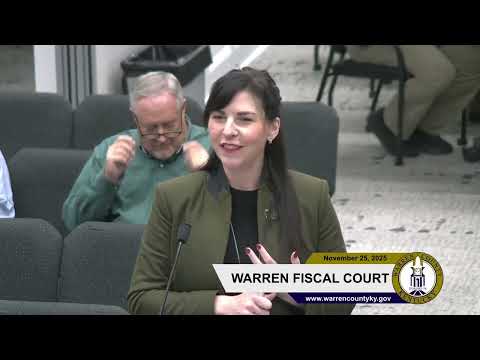
Amanda Haber, a representative of Origin Story Health, told the Warren County Fiscal Court on Tuesday that $91,500 the court allocated from opioid-abatement funds allowed her team to keep its doors open and deliver care to 110 local residents with substance-use disorders. "Because of you, we treated 110 individuals with substance use disorder and opioid use disorder in this community," Haber said.
Haber said the original plan was to use roughly $65,000 for direct care (paying providers and maintaining health-records and e-prescribing systems), about $21,000 for grant-writing and another $5,500 for credentialing and contracting assistance. She told the court those amounts were “almost exactly how those funds were spent.”
The provider reported outcomes the group described as promising: 23 people accessed or remained on medication-assisted therapy, 12 clients reached one full year of sobriety and Haber said only two of the 110 people had relapsed and both had reengaged in treatment. "The national average for relapse is between 40 and 60 percent. We had just shy of 2 percent," she said.
Haber also described gaps and challenges. She said long delays in insurance paneling and piecemeal payments have hampered financial stability — "by months, it's about 18 months in some cases" — and that Origin Story Health failed to secure competitive state and federal grants that would have funded formal outcome measurement. She said local organizations have applied to the Kentucky Opioid Abatement Commission through multiple rounds but with little success: "Of the 189 grants to a 130 organizations in the Commonwealth, 1 has gone to Warren County for mental health prevention and treatment. It was for $27,000," she said, urging the court to examine why more of those award dollars have not reached Warren County.
Haber suggested several actions for the court to consider: funding midlevel prescribers supervised by local psychiatrists, creating graduate training pathways and residency-style internships, expanding telehealth partnerships, embedding advanced-practice nurses in pharmacies and clinics to extend medication-assisted treatment (MAT), and creating a local trust fund to allow clinicians to treat residents at Medicare rates while practices complete credentialing.
The court asked Haber for a follow-up report and options. Judge/Executive said the court would look forward to "a follow-up report and some options," and thanked Haber for the update.
Why it matters: The presentation gave fiscal-court members concrete measures of clinical activity and clear policy options for expanding local capacity. Court members said they appreciated the data and asked staff to include additional follow-ups when the court next discusses opioid-abatement funds.
Next steps: Haber offered to work with the county to evaluate possible programs; the court requested a follow-up report and options to consider at a future session.