Get Full Government Meeting Transcripts, Videos, & Alerts Forever!
Get email alerts on the Criminal Justice topic
No spam. Unsubscribe anytime.
Tennessee Supreme Court weighs whether belief a person was a minor can sustain trafficking conviction in State v. Bayless
Summary
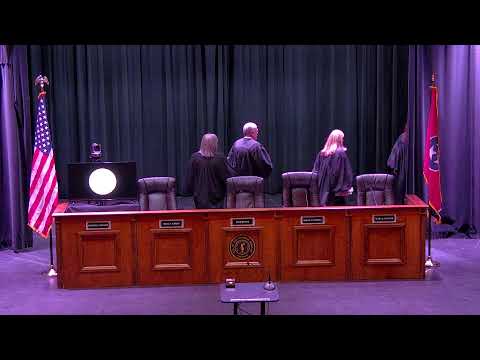
At a December 2025 "Scales" session at Bryan College, the Tennessee Supreme Court heard arguments over whether a defendant’s belief that a person was under 18 — including when the person was an undercover officer — satisfies the trafficking statute’s elements, or whether the statute requires proof the person actually was a minor.
The Tennessee Supreme Court heard oral argument in State of Tennessee v. Anthony Cornelius Bayless during its December 2025 Scales session at Bryan College, focusing on whether the state may prove a trafficking offense by the defendant’s belief that the other person was a minor or must prove the person was actually under 18. Chief Justice Jeff Bivens opened the session, calling Scales "the supreme court advancing legal education for students," and the court recessed for student questioning after arguments.
Defense attorney Bob Jolly told the justices there was "no proof in this record that Anthony Bayless subjected anyone to any act," and argued the statutory definition relied on by prosecutors requires proof the person was under 18 rather than simply the defendant's belief. Jolly emphasized gaps in the record, including the absence of coercion or deception and, he said, that jury instructions did not define "attempt" — an issue he urged the court to consider when evaluating sufficiency of the evidence under Jackson v. Virginia.
Representing the state, Aaron Bernard of the Attorney General’s Office urged affirmance of the Court of Criminal Appeals, arguing the evidence at trial showed Bayless believed the other person was 16, that he took substantial steps (including travel and text communications) toward consummating the plan, and that the statute’s "attempt" element turns on the defendant’s belief about the victim’s age. "Bayless's trafficking pitch combined with his substantial steps towards completing that pitch is sufficient evidence to affirm his conviction," Bernard said. Counsel and the bench also discussed a statutory provision that specifically addresses prosecutions when the intended victim is a law‑enforcement officer posing as a minor; Bernard described that subsection as a "belt and suspenders" provision that clarifies application to sting operations but does not render the attempt theory superfluous.
Justices probed whether relying on the attempt/belief theory would effectively swallow subsection (a)(3) — which refers to law‑enforcement officers posing as minors — or whether both readings coexist depending on the facts. The court also discussed whether the trial court's jury charge should have included a definition of attempt and whether that omission affects the sufficiency review. Counsel referenced statutory text repeatedly (record citation in argument: the code sections discussed as "39 13 3 0 1 4" and "3 0 9 a 1/3" in the transcript) and pointed to record evidence including text messages and testimony of a TBI agent.
No vote or opinion was announced from the bench during the session; the court recessed for student questioning and said that written opinions from today's arguments will be posted on the court's website. The session included introductions of each justice and logistical acknowledgements to Bryan College and local law‑enforcement partners.