Guam bill would make Community Health Centers autonomous; DPHSS supports phased transition
Summary
Bill 169 would transition Guam Community Health Centers into an autonomous agency to meet HRSA requirements, expand services and streamline hiring. DPHSS and the GCHC board support the measure but urged a phased transition, protection of program income and planning for EHR, workforce and facility responsibilities.
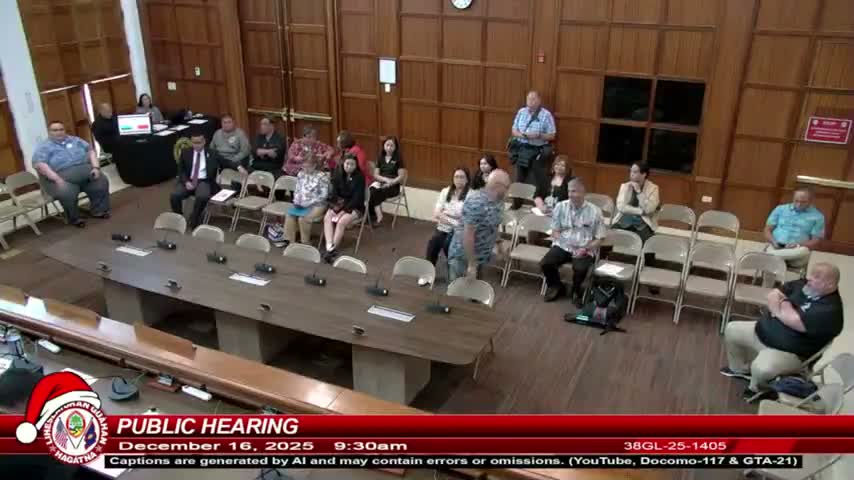
Lawmakers and public-health officials on Dec. 16 debated Bill 169, which would amend Article 8 of Chapter 3, Title 10 of the Guam Code Annotated to transition Guam Community Health Centers (GCHC) into an autonomous agency.
Sponsor Sen. Therese Turlahi framed the legislation as a response to a previous vetoed effort and said the bill aligns board selection, bylaws and duties with HRSA (the federal Health Resources and Services Administration) so Guam’s centers can preserve FQHC designation and federal funding. “The bill mandates the transition of the community health centers program under public health to an autonomous agency,” she said, and the text includes a phased transition period.
Theresa Areola, director of the Department of Public Health and Social Services, testified her department supports autonomy but urged a carefully phased approach. Areola said GCHC currently serves more than 8,500 unduplicated patients a year and averages nearly 2,000 encounters a month; autonomy would bring benefits — flexibility in hiring, ability to expand urgent and after-hours care, and better alignment with federal FQHC rules — but also creates new administrative responsibilities.
Areola recommended an immediate formal readiness assessment: financial modeling, workforce planning and clarifying who will own facilities and utilities after transition. She warned changes at HRSA and pending federal reforms (Medicaid reform expected in 2026 and HRSA rule changes) make timing and sequencing critical. She asked the bill to explicitly protect program income so funds generated by CHC operations (pharmacy, patient collections) are not redirected during transition.
Melissa Savarez, chair of the GCHC board, and other board members said autonomy would allow the board to select a CEO, hire critical positions such as a chief financial officer, and exercise co-applicant and procurement flexibility required by HRSA. Savarez also asked that tax-refund garnishment authority (for collection of outstanding patient debt) be retained or restored in bill language.
Students and medical trainees with Chalan Amti and visiting medical students testified that autonomy would strengthen training opportunities, increase eligibility for HRSA workforce programs such as the National Health Service Corps and support efforts to build local residency and recruitment pipelines.
Senators questioned witnesses about a sustained drop in GCHC patient counts (transcript testimony cited 11,592 patients in 2019, 8,698 in 2022 and 8,551 in 2023), EHR procurement plans estimated at over $50 million, and a prior period when some CHC services were repurposed during the COVID-19 response. DPHSS and board representatives said procurement delays, gaps in vaccine ordering and staff shortages had contributed to temporary drops in utilization and that restoring predictable staffing and procurement is essential to regain patients.
Committee members thanked witnesses and said they will move to markup and prepare a committee report. No final committee vote was recorded at the hearing.