
Massachusetts high court hears argument on meaning of 'not less than 2 and a half years' in G. L. c. 269, §10(m)
Get AI-powered insights, summaries, and transcripts
Subscribe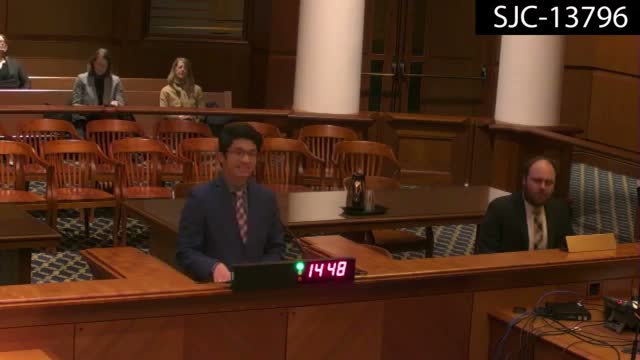
Summary
At oral argument, the Commonwealth urged the Supreme Judicial Court to give effect to the phrase 'not less than 2 and a half years' in G. L. c. 269, §10(m), while defense lawyers argued alternative readings and urged deference to plea‑deal finality; the panel pressed both sides on precedent and statutory silence.
BOSTON — The Massachusetts Supreme Judicial Court heard argument on whether the phrase “not less than 2 and a half years” in G. L. c. 269, §10(m) must be read as a mandatory minimum or can be harmonized with other provisions that appear to permit shorter service.
Special Assistant District Attorney Chi Chi Lee, arguing for the Commonwealth, told the court: “This is a case about applying the plain meaning and a rule against superfluity to section 10 m to reflect the legislative intent.” Lee urged the justices to give the phrase meaning rather than rendering it meaningless under precedent the Commonwealth describes as erroneous.
The Commonwealth framed the dispute as one of statutory construction and precedent. Counsel argued that treating the 2.5‑year clause as the effective mandatory minimum is necessary to avoid making statutory language superfluous and relied on comparative statutory drafting across related sections. The attorney pressed that Rodriguez was wrongly decided and that other authorities (including Da Silva and Rossetti) do not require the court to accept Rodriguez’s reading wholesale.
Justices repeatedly tested whether the phrase is genuinely ambiguous and whether the rule of lenity — which favors defendants when a criminal statute is ambiguous — would apply. One justice asked, “Isn’t it ambiguous?” and pressed whether the 2.5 figure could reasonably be read as a ceiling on the minimum rather than a floor. Counsel for the Commonwealth responded that the only workable way to give the statutory phrases meaning is to read the earlier clause as imposing a meaningful 2.5‑year term.
Defense counsel proposed alternative constructions. Timothy St. Lawrence, representing Stefano Sikarakis, told the court a different reading is plausible: the 2.5 years can be viewed as a “maximum minimum” — a cap on the lower bound that preserves judicial discretion over the lower term a judge may set. “It can be viewed as a maximum minimum because it would keep it as a minimum term,” St. Lawrence said, arguing that approach would avoid creating a new mandatory floor that would restrict judges unduly.
Counsel and the panel explored how the statute’s three clauses — the not‑less‑than 2.5 language, a clause stating persons with an FID card “shall not be subject to any mandatory minimum,” and a separate one‑year reference — can be reconciled. The exchanges probed whether legislative silence after Rodriguez (including a 2024–2025 revision tied to Bruhn) should be read as acquiescence or as neutral.
Keith Durden, representing Maurice M. Smith, emphasized the collateral consequences of a changed interpretation for plea‑deal finality, saying Smith has “practically served the sentence” and asking the court to consider the interest of justice and finality if it were to find the sentences illegal. Defense counsel urged that, even if the court finds a legal error, principles of finality under Commonwealth v. Ellsworth could counsel affirmance in the interest of justice.
The arguments explored statutory drafting choices, administrative consequences for the Department of Correction, and competing concerns about uniformity and judicial discretion. Counsel for both sides acknowledged the statute is imperfect; the exchanges focused on whether the court should correct what the Commonwealth called an earlier error in Rodriguez or uphold Rodriguez as a practical compromise.
Arguments concluded in the hearing transcript provided; no decision appears in the record of oral argument.
The court heard extended debate over statutory text, the reach of Rodriguez and Rossetti, and the effect of legislative silence; a ruling is expected in the court’s ordinary course.