
Defense urges reversal in Williams appeal, court questions GSR use and premeditation inoral argument
Get AI-powered insights, summaries, and transcripts
Sign Up Free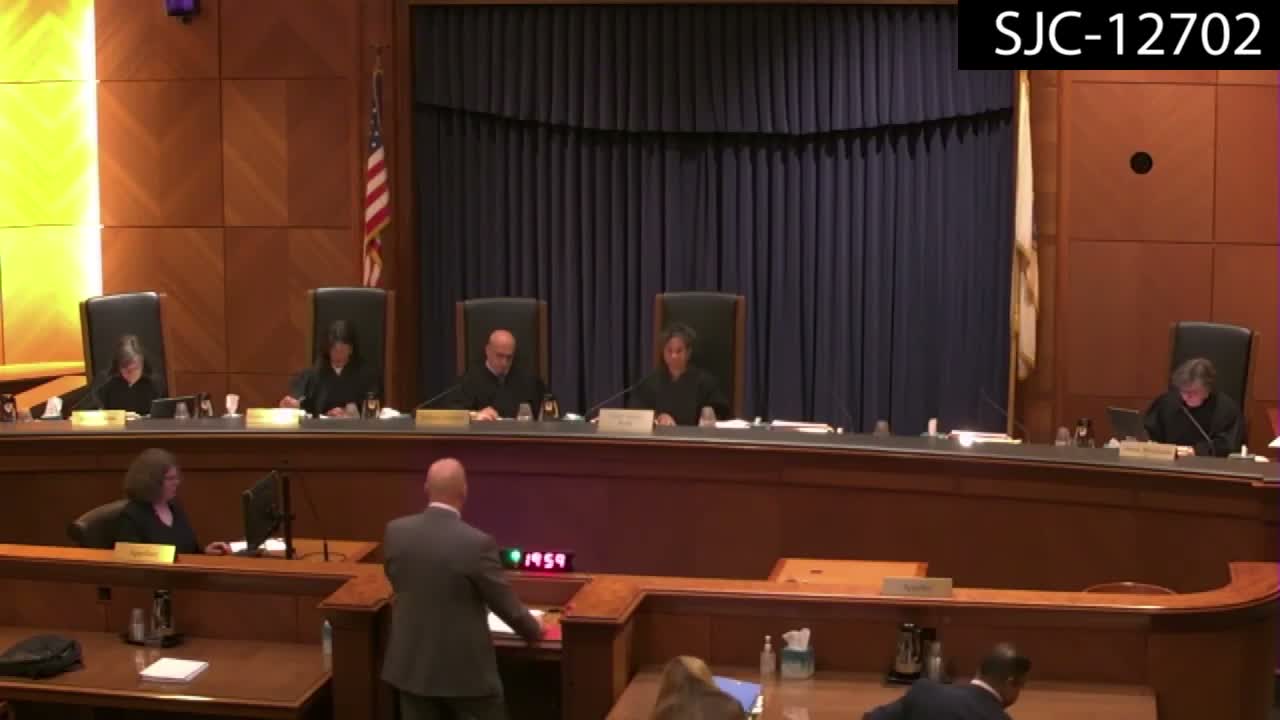
Summary
At oral argument in Commonwealth v. Keith Williams, defense counsel urged reversal for insufficiency of evidence, ineffective assistance and prosecutorial misconduct; the Commonwealth said the record supports deliberate premeditation and urged affirmance. Justices pressed both sides on gunshot-residue evidence and appellate standards.
BOSTON — In oral argument before the state Supreme Judicial Court in Commonwealth v. Keith Williams, defense attorney Robert Shaw told the justices that the record does not support the Commonwealth’s theory that Williams deliberately planned a killing and that trial counsel left jurors without legal tools to consider defensive or mitigating theories. "Facts matter," Shaw said as he opened his argument, contending that no witness identified Williams as present at the market and that the other group "walked away" before Colas returned and drew a firearm.
Shaw argued the sequence — a brief exchange, the other group leaving, and Colas returning within seconds and pointing a gun — "negates the gun battle narrative," and he urged that the evidence shows a panicked, unplanned reaction rather than deliberate premeditation. He pressed that prosecutors relied on emotional appeals and references to evidence not before the jury, including repeated gang-related innuendo, and that those tactics prejudiced the verdict.
"This was not a case of overwhelming evidence," Shaw said, urging the court to consider ineffective-assistance and prosecutorial-misconduct claims on the record and to scrutinize how the trial treated potential mitigation and self-defense theories.
The parties spent significant argument time on gunshot-residue (GSR) testing. Shaw told the court that a negative GSR test under the lab’s standard is not probative of shooter identity and that microscopic particles can result from secondary transfer; he said the prosecutor nevertheless urged jurors to treat the limited residue evidence as central to guilt. "The test was negative," Shaw said, and he argued it should not have been used to press an inference of identity beyond what the scientific threshold allowed.
Brooke Hartley, arguing for the Commonwealth, told the court it should affirm the convictions and said the record supports a finding of deliberate premeditation. "This court should affirm the defendant's convictions and remand the case for a hearing pursuant to Commonwealth v. Mattis," Hartley said. Hartley listed evidence the Commonwealth says supports intent: multiple eyewitness accounts of several shots fired, a recovered revolver with six spent casings, testimony placing a firearm in a person’s hand at the scene, and the close physical proximity of the events.
Hartley defended the admissibility and probative value of GSR under existing precedent, telling justices that Johnson permits jurors to consider particle evidence and draw reasonable inferences when experts explain testing standards. The bench repeatedly probed both sides on whether GSR should be treated like other forensic evidence (such as DNA or fingerprints), noted concerns about contamination and the FBI’s shifting stance on GSR reliability, and asked how closing argument language might invite improper speculation.
The justices also focused on appellate standards: they reminded defense counsel that, on sufficiency review, the record must be viewed in the light most favorable to the Commonwealth and asked both sides to identify which inferences the jury reasonably could draw. Hartley cited Santiago-related instructions and case law that a participant in a shootout may be held responsible even if the other party’s gun did or did not fire first.
The argument encompassed three principal strands the court will weigh on appeal: (1) whether the evidence supports a verdict of deliberate premeditation rather than a reactive, defensive shooting; (2) whether counsel’s tactical choices at trial amounted to ineffective assistance that deprived the jury of mitigation or self-defense instruction; and (3) whether the prosecution’s use and characterization of GSR evidence at trial prejudiced the jury. The justices asked detailed questions on each point and sought clarification about the record’s specific facts, including witness positioning, the number of shots, and timing.
The court took the arguments under advisement at the close of the session; no decision was announced. A separate procedural request by the Commonwealth that the case be remanded for a Mattis hearing was raised during argument.