
Bristol Council votes to abate two-family home tax for Pokanoket management group after extended hearing
Get AI-powered insights, summaries, and transcripts
Subscribe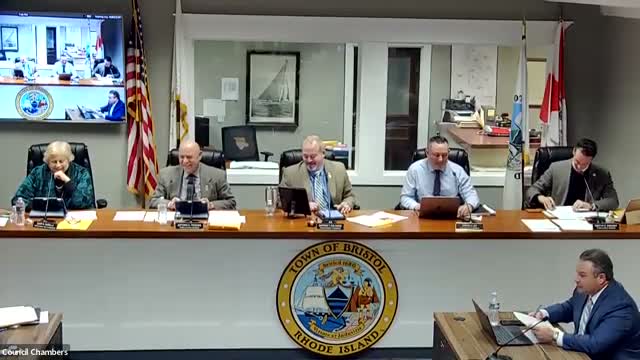
Summary
After a lengthy public hearing and testimony from tribal representatives and caretakers, the Bristol Town Council voted to abate $13,809.98 in property tax for the two-family residence on Parcel 135‑0012‑000 owned by the Pokanoket Management Group; one councilor recorded opposition.
The Town of Bristol Council voted Dec. 10 to abate $13,809.98 in property tax attributable to a two-family residence on Parcel 135‑0012‑000 owned by the Pokanoket Management Group, following a detailed presentation from the town solicitor, questions from council members, and multiple public statements from tribe representatives and property managers.
Solicitor Andy Tights summarized the legal background and the tax-stabilization framework that accompanied Brown University’s conveyance of roughly 224.93 acres and associated parcels to the Pokanoket Management Group. He said the state pilot program was designed to reimburse municipalities approximately 27% of lost tax revenue on nonprofit or tax-exempt transfers on a delayed, look‑back basis, but that the town’s tax‑stabilization agreement included a clause allowing the council to consider abatements under Section 8 of that agreement.
Ty Palermo, representing the Pokanoket Management Group, and tribal speakers described the stewardship work and the caretaking arrangement. Property manager Tony Marie Walmsley explained caretakers’ duties — maintenance, trail upkeep, trespass monitoring, and security coordination with Bristol police — and appealed to the council for relief. Tribal member Seysham Tracy said the tribe had been back on the land only a year and pressed for a full abatement, saying the group “is not a tribe that receives federal funds” and that current revenues are insufficient to cover stewardship needs.
Town staff and the solicitor said the tax‑stabilization agreement contemplated providing relief to preserve historic values and allowed the town to grant abatements if in the public interest. The town assessor and finance staff presented numbers showing a roughly $13,809.98 tax bill on the two-family building (and a larger agreed-upon valuation for the acreage that is recognized under the stabilization arrangement). The solicitor and finance director recommended a 50% abatement for the current year as a balanced approach; several council members suggested phased approaches or a zero bill for year one while allowing the tribe to return next year for reconsideration.
Council discussion emphasized competing responsibilities: supporting cultural preservation and stewardship while protecting the town’s budget and taxing base. One councilor framed the 50% recommendation as “fair” and grounded in revenue assumptions; others urged full relief to allow the tribe to stabilize operations and pursue grants. After debate, Councilor Mary (first name used in the transcript) moved to abate the full $13,809.98 for the current fiscal year; the motion was seconded and passed on a roll-call voice vote with one recorded opposed.
The abatement covers the property tax on the two-family residence for the current tax year; the larger acreage values were treated separately under the tax‑stabilization agreement and remain subject to the pilot reimbursement timeline. Council members and staff noted the tribe can return next year for additional consideration, and that the General Assembly’s pilot appropriation timing could affect long-term town revenue recovery.
Next steps: the finance department will record the abatement and adjust year-end budgeting. The council’s vote creates a one‑year relief for this parcel; any further abatements or a phased schedule would require a future council action and potential budget adjustments.