MSD presents 2026 budgets; community groups press for impervious-surface fee pilot
Summary
The Metropolitan Sewer District presented a 2026 operating budget of $255.9 million and a $153.6 million capital request, while promising no residential rate increase for 2026. Environmental groups urged an impervious-surface fee and MSD described plans for a targeted pilot and rate-design changes to shift more costs to high-volume commercial users.
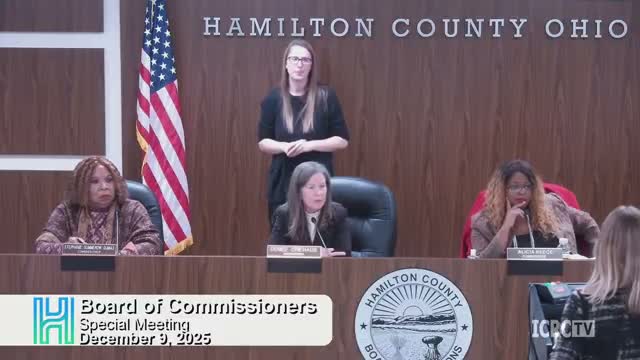
The Metropolitan Sewer District (MSD) presented the 2026 operating budget ($255.9 million) and capital program ($153.6 million request, $84.4 million appropriation upon passage) to the Hamilton County Board of Commissioners, explaining cost drivers and the district—s approach to rates and capital planning.
MSD's director told commissioners and the public that rising personnel costs (about $8 million related to negotiated cost-of-living increases), higher power and supplies costs, aging infrastructure and federally mandated consent-decree work are increasing pressures on operations and capital. The district said it manages roughly $2 billion in projects and has completed multi-year consent-decree phases that now define the next five years of capital priorities.
To meet a roughly 4.5% revenue need, MSD proposed adjustments to its cost-of-service assumptions and a simplification of the consumption charge from a two-tier to a single rate for volume above the minimum base. MSD said that approach will allow residential customers to see no rate increase for 2026 while shifting more of the revenue burden to high-volume commercial and industrial users; the district estimated some high-volume customers could see increases as high as about 15% depending on usage and meter size.
The rate-design and revenue plan prompted public comment from environmental and community-advocacy groups pressing for an impervious-surface fee (ISF) to make large paved-property owners pay for stormwater that enters the combined sewer system. Larry Falcon of the Sierra Club Miami Group argued that "large land owners" putting runoff into the combined system are not paying their fair share. Community groups (CUFA and Sierra Club) urged the commissioners to include an ISF in the budget, citing repeated sewer backups and inequities in the current structure.
MSD's director said prior stakeholder feasibility work found operational complexity and lack of consensus for a systemwide ISF because MSD is a wastewater utility and not a standalone stormwater utility in many jurisdictions; she noted the city of Cincinnati and some other municipalities charge stormwater fees as a separate utility. MSD said it plans a targeted pilot to work directly with large combined-system properties to measure runoff, detention and potential on-site improvements and will return to the board with a proposal in early 2026.
Commissioners pressed MSD on sources of funding, impacts on restaurants and small businesses, and whether the projected commercial increases could be locked or would continue in future years. MSD reiterated that its budgets are funded by ratepayers and said the financial analysis shows a continuing need for revenue increases over coming years given the consent-decree capital program.
MSD also confirmed the sewer-backup program funding would remain at $8.8 million for 2026 to cover response, claims and prevention work. The board heard the presentation, public comment and questions; no final MSD rate vote occurred during the hearing.