Get Full Government Meeting Transcripts, Videos, & Alerts Forever!
Get email alerts on the Governance topic
No spam. Unsubscribe anytime.
Fairfield-Suisun trustees reject changes that would reduce vice president’s formal role in agenda preparation
Summary
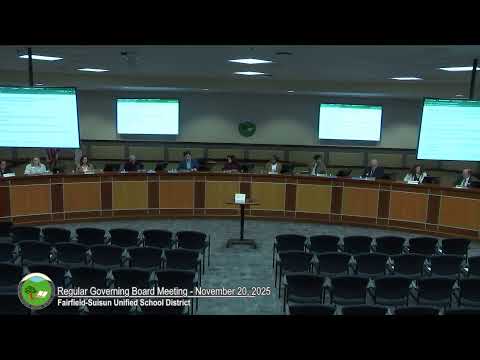
Trustees voted 5–2 on Nov. 20 to reject proposed governance bylaw revisions that would have removed the vice president from routine agenda-preparation meetings and allowed the president to name a designee. Board members who opposed the changes said they preserve checks and training for future officers.
The Fairfield-Suisun Unified School District governing board voted on Nov. 20 to reject proposed revisions to multiple governance bylaws that would have removed the vice president from a formal role in agenda preparation and replaced that role with a president-designated designee.
Vice President (Trustee) Wilson moved to “not adopt” the proposed changes to items listed as 10p and 10w and to oppose the modification to bylaw 9240 on board training (item 10s), saying the proposed language had been introduced without adequate prior disclosure and that keeping the vice president involved provides an important check and a training opportunity for upcoming officers. “Once a year we readopt everything … there was a proposal to amend that wasn’t previously disclosed and I objected,” Wilson said during debate.
Trustee Flynn, who led the governance subcommittee and supported aligning district language with California School Boards Association (CSBA) model policy, said the changes were intended to make attendance at agenda-prep meetings optional and to align FSUSD policy with common practice elsewhere. “It’s about making it more open and not mandatory,” Flynn said, adding the language does not ban participation.
Other trustees stressed the need for a three-person check to avoid concentrating agenda control in two hands. “If there is a problem with overreach by either the president or the superintendent, the only way to resolve that is to have three people in the meeting,” one trustee said.
After extended discussion and a proposed compromise to change mandatory language to permissive language in a subparagraph, the board voted on each pulled item. The motions to reject the proposed revisions passed, leaving existing bylaws in place. The transcript records votes on item 10p as failing to adopt the change by a 5–2 margin (Trustees Hundley and Flynn opposed the motion to reject), and similar outcomes for 10s and 10w, preserving the status quo for governance, training reporting, and agenda-preparation language.
The debate reflected differing views about aligning district policy with CSBA guidance versus preserving local accountability mechanisms such as required travel reporting and board-developed professional development calendars. Trustees suggested follow-up options including workshop or retreat discussions to seek compromise language.
The board did not adopt the governance changes under consideration and directed that the existing language remain in effect. Trustees who supported revision said they would pursue a more collaborative route through committee or retreat to refine language before bringing future proposals back to the board.