Get Full Government Meeting Transcripts, Videos, & Alerts Forever!
Get email alerts on the Affordable Housing topic
No spam. Unsubscribe anytime.
Bay City Housing Commission outlines plan to transfer 193 public-housing units to nonprofit, pledges tenant protections
Summary
The Bay City Housing Commission presented a plan to convert the remaining 193 public-housing units to nonprofit ownership to access additional financing; officials said current tenants would keep existing assistance and recertification requirements, and deed restrictions would preserve affordability.
The Bay City Housing Commission on Dec. 1 told the City Commission it plans to finish a long-running “repositioning” that would move 193 public-housing units into a nonprofit-managed portfolio to access grants and other capital not available to a public housing authority.
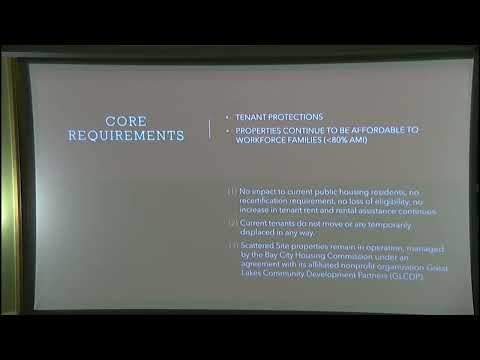
A Housing Commission representative described the move as the final step in a reorganization begun in 2015 that already converted most of the authority’s inventory to multifamily programs. The presenter said the transfer is not a sale for profit — “there’s no money in this transaction,” he said — and that the housing authority will cover nonprofit closing costs while current tenants keep their rental assistance and recertification rules.
Commissioners pressed staff for specifics. Commissioner Kubit asked for clarity about counts and regulation differences; the presenter repeated the figures used in the briefing — 193 total units remaining, organized in 151 buildings that include 42 duplexes — and said the operational rules governing tenancy would change only in technical ways, not by removing key tenant protections.
The presenter told the commission deed restrictions would be recorded when properties exit the public-housing program. A staff speaker described an “80% deed restriction” that, according to the presentation, would keep units affordable; when asked whether those restrictions were permanent, staff said they expected them to be “in perpetuity as far as I know.”
Officials said the move is designed to broaden access to capital — grants, private and state programs, and other financing — to support rehabilitation and new affordable units. The presenter said a planned Columbus Avenue development could add roughly 112–128 units and that staff anticipate applying for financing in the next funding window, with a planning-committee presentation likely in January.
Commissioners and public commenters urged continued transparency and detail for tenants: Commissioner DeWitt asked whether deed restrictions could expire; public commenters asked whether a transfer might allow future private-market sales or rent increases years down the line. The presenter said residents have been informed at two resident meetings and via direct mailings and that staff will continue outreach as plans develop.
Next steps: staff expect to bring alternate site plans to the planning committee and continue tenant outreach; no formal action was taken on the repositioning plan during the commission meeting.