Get Full Government Meeting Transcripts, Videos, & Alerts Forever!
Get email alerts on the Policy Changes topic
No spam. Unsubscribe anytime.
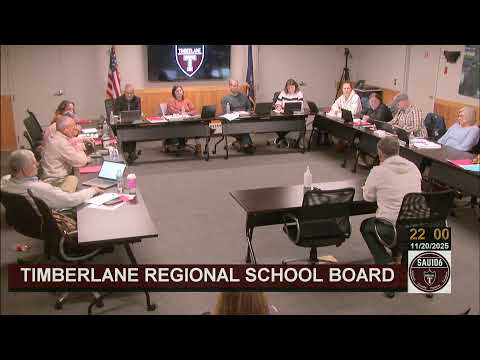
Board takes first reads on state-driven policy changes for extended learning and graduation requirements
Summary
In response to changes in state ED 306 rules, Timberlane took first reads and approved revisions to policies on extended learning opportunities and graduation requirements; the ELO policy will allow competency-based course credit and the district will keep three diploma tracks while moving specifics into the program-of-studies.
The Timberlane board conducted first readings and votes on multiple policies required to implement changes to New Hampshire—s ED 306 minimum standards.
The board reviewed a revised extended-learning-opportunities policy (IHBH) that formalizes pathways — independent study, internships, apprenticeships, remote learning and more — through which students can now earn competency-based course credit. "All ELOs that students engage in, they will go through an approval process," the policy presenter said, noting the district will require rubrics and administrative review to ensure an ELO aligns with graduation competencies.
The related alternative-learning-plans policy (IHBI) includes a proposed placeholder cost threshold (policy committee used $4,000 as a benchmark tied to average CTE program costs) that would trigger board-level review for particularly expensive placements; board members asked the committee to revisit that dollar threshold and suggested alternatives such as a per-year cap ($2,000 suggested by one member) or a capped pool of funds for extraordinary expenditures.
Board members also reviewed proposed changes to instructional-materials policy (IJ) and a major revision on graduation requirements (IKF), which will move many specific diploma requirements into the program-of-studies document that the board will review in December. The district indicated it will continue to offer three diploma tracks by choice: a standard diploma proposed at 23 credits, a technical diploma at 24 credits and a scholastic diploma at 26 credits, exceeding the state—s minimum of 20 credits. Staff noted two statutory requirements: a passing score on a civics/naturalization item bank and notification/assistance on FAFSA completion; one member raised a FERPA concern about language requiring the superintendent to provide a copy of a student—s completed FAFSA on request and asked staff to review that provision.
Each policy was approved for first read and will return for subsequent votes with any committee revisions. The board also voted to repeal several obsolete policies superseded by the new language.
Next steps: staff will bring the program-of-studies with the detailed credit charts back for a first read in December, and policy committee will refine the IHBI cost/exception threshold language for board consideration.