Get Full Government Meeting Transcripts, Videos, & Alerts Forever!
Get email alerts on the Budget Default topic
No spam. Unsubscribe anytime.
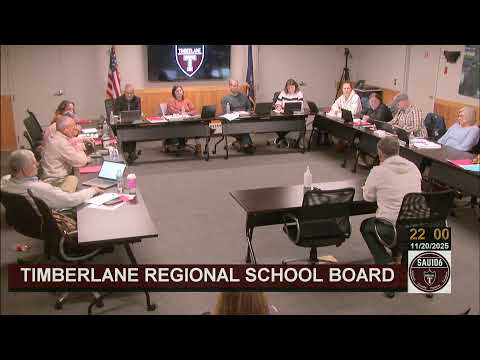
Timberlane board reviews default budget as special-education and benefits costs push default above voted budget
Summary
Finance staff presented a default budget totaling $90,497,479, up from the voted $82,334,912; the board heard that salary and benefit increases plus a $2.35 million rise in special-education contracted services largely drive the change and requested more analysis on transportation impacts.
Finance staff told the Timberlane Regional School District school board on Nov. 20 that the district—s default budget calculation produces a total of $90,497,479, compared with the current voted operating budget of $82,334,912. The presentation traced $8,162,567 in default-driven increases, including a $2,079,034 rise in salaries and a $2,349,767 jump in special-education contracted services.
"Default budget as used in this subdivision means the amount of the same appropriations as contained in the operating budget authorized for the previous year, reduced and increased as the case may be by debt service, contracts, and other obligations previously incurred or mandated by law," a staff member read aloud from the statutory definition included in the packet. The staff presentation included line-item detail and a spreadsheet comparing the voted budget and the proposed default by category.
Board members pressed staff on the special-education increase and how transportation costs are represented. Finance staff said the SPED contracted-services increase reflects restored service levels after program cuts and a roughly 5% year-over-year contract inflation used for projections. The presenter explained that SPED tuition decreased because the district has expanded in-house programs and thus can retain some students rather than sending them to other districts.
Board members also raised concerns about regular transportation. "We learned that for the default budget, we cannot include the increase in regular transportation; it is not allowed by law to be included in the default budget now," a staff member said, adding that the restriction had been confirmed by the district—s attorney. Members noted the district had already removed $500,000 from the regular transportation line in the voted budget and that the vendor contract includes a per-bus per-day rate increase of roughly $20.
The board asked staff to prepare a route-by-route analysis showing how many buses could be eliminated and the likely dollar savings if the district moved toward the statutory minimum standard for service (a two-mile threshold). Finance staff also ran through the dashboard and fiscal-year-to-date numbers: year-to-date revenue of $25,746,897 versus $24,589,904 a year earlier, expenses of $21,299,667, a student count of 8,213, 592 active employees, and 65 special-education contractors (roughly 54.5 FTE equivalents).
Several board members urged no immediate vote on the default budget and instructed staff to provide more granular detail before any action. "So lots to digest," the chair concluded, recommending that the board take additional time to review the packet before voting at a later date.
Next steps: staff will provide a transportation savings analysis and any additional backup for SPED and benefit projections for the board—s December meeting.