
Clerk of courts outlines postage shortfall, bailiff workload and Help Center expansion
Get AI-powered insights, summaries, and transcripts
Subscribe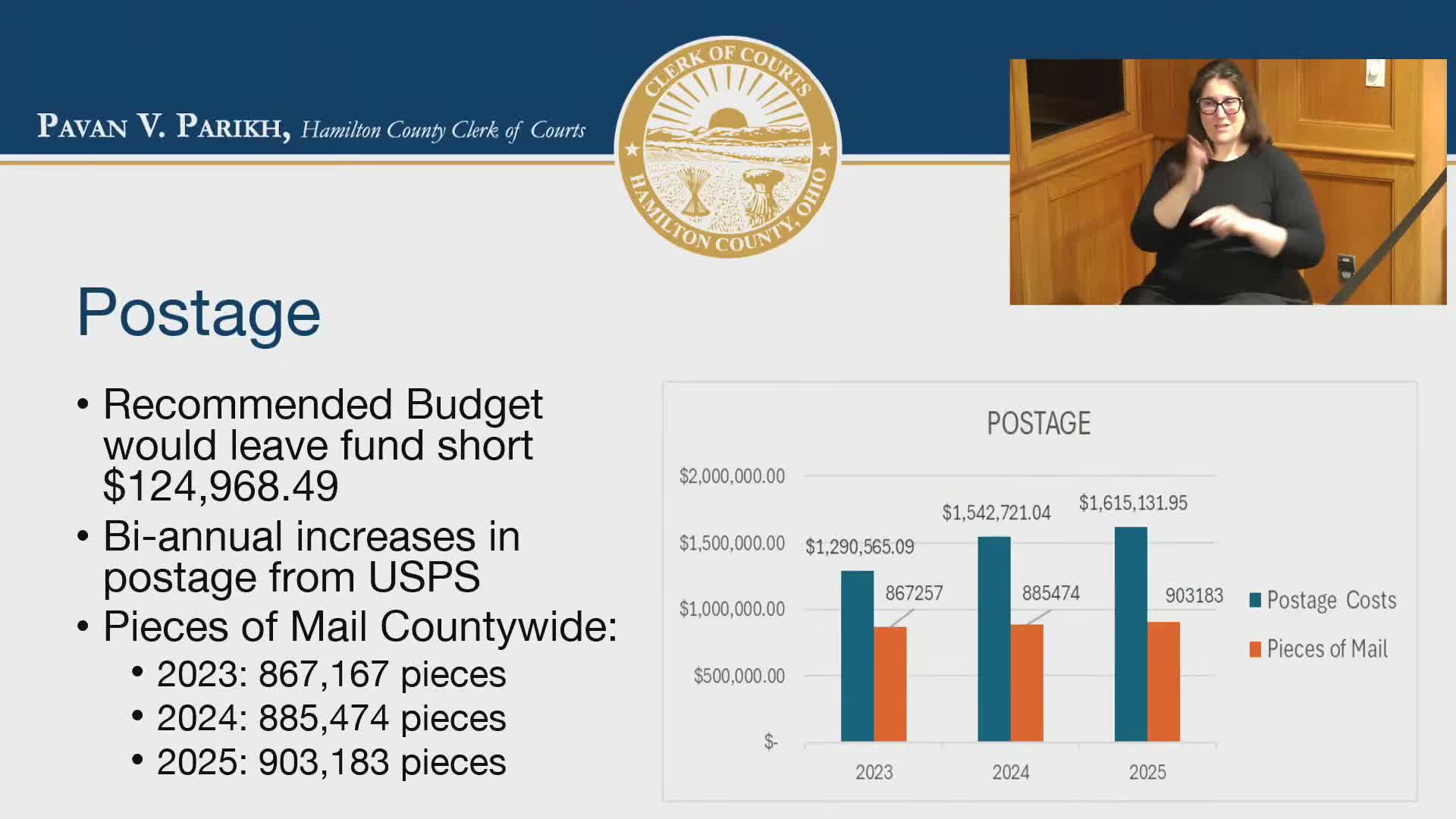
Summary
Clerk Pavan Parikh told commissioners a postage shortfall (~$124,968.49) and increasing bailiff workload are driving his budget request and that the Help Center eviction-prevention pilot will expand to five days a week; a transcripted grant amount was inconsistent and recorded as not specified.
Pavan Parikh, Hamilton County clerk of courts, detailed several operational pressures and proposed uses of restricted funds during the Dec. 9 staff meeting. He told commissioners the office anticipates a postage shortfall of $124,968.49 driven by mandatory mailings, case filings and expected USPS rate increases. “We just received notification that postage will go up 6% in January,” Parikh said.
Parikh also said the bailiff division is busier than in prior years: the office recorded 8,202 inmate transfers in 2024 and reported 8,572 hours of courtroom security work. He warned that collective-bargaining wage steps and annual adjustments will raise costs roughly 6% for the bargaining unit in 2026 and that the division is operating with thin margins across 14 morning courtrooms.
Parikh described the closure of a 31,000-square-foot records center earlier this year, the relocation and disposition of records, and temporary conversion of the facility for animal sheltering during a crisis. He noted the clerk’s office has used the records transition to create efficiencies and recover assets.
On eviction prevention, Parikh said the Help Center is on track to assist about 25,000 people in 2025 across municipal, common pleas and juvenile courts and that he is seeking expansion of a limited representation eviction program to five days a week to serve all county residents. The transcript contains an inconsistent grant figure reported during the presentation; that figure is recorded as not specified here because the number in the record appears garbled.
Parikh discussed a statutory change to the clerk automation fund in Oct. 2024 that moved a per-case fee under clerk control and prompted the office to raise the fee to the maximum allowable to replenish automation-fund revenues. He said the office believes restricted automation funds can permissibly support case-management-system upgrades and other automation efforts without relying on the county general fund.
Commissioners asked for more context on eviction trends; Parikh pointed to housing scarcity, rising rents, and institutional landlord activity as drivers and said the Help Center’s pilot produced a substantially higher success rate in keeping tenants housed (rising from an estimated ~45% to about 86% for represented tenants in the pilot period). Parikh and commissioners discussed measuring outcomes and continuing coordination with city partners and researchers.