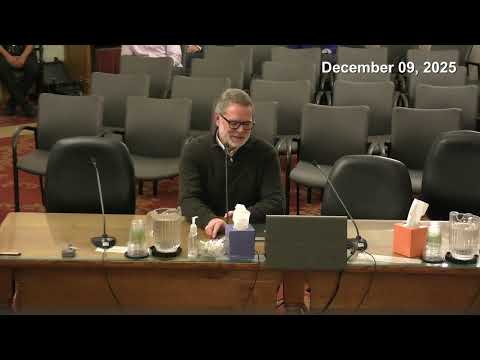
Chief Redd updates council on Connect program, crime trends and proposed real-time crime center
Loading...
Summary
Chief Redd briefed the council on the mayor’s public-safety plan, reporting a 28.4% reduction in arrests among the city’s top 50 high-utilizer individuals since the Connect interventions began, described heat‑map–driven responses, and outlined plans for a real‑time crime center (cameras, LPRs and limited drone use) with policy safeguards and privacy review.
Salt Lake City’s police leadership updated the council on progress implementing the public-safety plan and the city’s Connect program Dec. 9, reporting measurable reductions for a small group of high‑utilizer individuals while previewing a proposed real‑time crime center and policy safeguards for surveillance tools.
Chief Redd said the Connect program focuses social‑worker resources on the roughly 50 individuals who have the most frequent interactions with city responders, with partners including the Road Home and mental‑health providers. "Since we started the Connect program, arrests for these individuals are down 28.4 percent," Redd told the council.
Staff showed heat maps of homeless‑related calls and described targeted interventions that shifted enforcement and services from the Jordan River Trail to other hot spots; the department said surges of enforcement and service coordination (including temporary closures for remediation) have reduced the highest concentrations of calls for service.
The chief described a proposed real‑time crime center that would use cameras, license‑plate readers (LPRs) and deployable drones to support priority 1–2 incident responses. He emphasized state law and local policy will govern access: LPRs are audited and accessible when there is a crime or reasonable suspicion, facial recognition is not being integrated, and the center is intended to support real‑time officer safety and investigations rather than continuous surveillance of residents.
On data sharing and vendors, the chief said the department does not share LPR data with ICE and that the city would retain and control data distribution, while noting he has been meeting with the Racial Equity and Policing Commission and the ACLU to develop accompanying privacy safeguards. Council members pressed about oversight, the possibility of vendor resale of data, and equitable placement of devices to avoid disparate impacts; staff agreed to continue policy work and community engagement as grant timelines and budget amendments are considered.
Council discussion also explored citation and enforcement strategy trade-offs, and members asked staff to characterize resource needs and policy options as budget and ordinance decisions move forward.