Get Full Government Meeting Transcripts, Videos, & Alerts Forever!
Get email alerts on the Enforcement topic
No spam. Unsubscribe anytime.
California Underground Safety Board finds multiple contractors in violation, levies education and fines
Summary
At its Nov. 18 meeting the California Underground Safety Board found multiple contractors violated state excavation rules after hitting subsurface gas lines or failing to respond properly. The board ordered mandatory education in most cases and levied fines ranging from $500 to $4,000.
The California Underground Safety Board on Nov. 18 resumed enforcement hearings it recessed the previous day, issuing findings of violation and sanctions in a series of Notice of Probable Violation (NOPV) cases involving excavators and contractors across the state.
The board repeatedly concluded that failing to call the regional notification center (811) before digging, and failing to call 911 after a confirmed gas release, violated California’s Dig Safe Act provisions (Gov. Code §4216 and implementing Title 19 regulations). Where companies cooperated and admitted fault, the board generally ordered mandatory completion of the board’s education course; in many cases it added modest financial penalties to reinforce compliance.
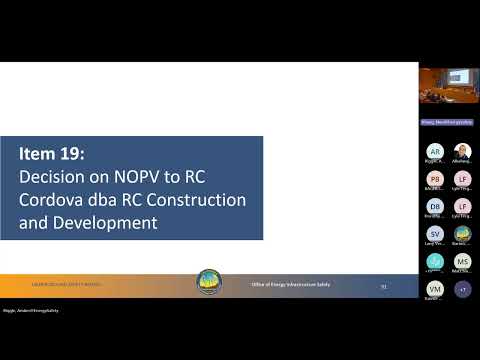
Key outcomes (board motions adopted): RC Cordova dba RC Construction & Development (Investigation N2422214) was found in violation of §4216.2(b) (no 811 ticket) and §4216.4(c)(1) (failure to call 911). The board ordered mandatory completion of the board’s education course and a $2,000 penalty. HydroTek Pipe Services (Investigation N242831700) was found to have no ticket and no 911 call; the board ordered education and a $2,500 penalty. West Coast Building & Design was found to have excavated without an 811 ticket; the board recommended education and a $3,000 penalty.
JS Plumbing (Investigation N250381136) — which responded to the NOPV and explained that an assumed general-contractor ticket left field responsibilities unclear — was found to have violated §4216.2(b) but the board limited the sanction to mandatory education (no fine), reflecting cooperation and remedial steps.
Padre Dam Municipal Water District testified at an informal hearing that a March 2025 GIS and email upgrade affected its ability to deliver an electronic positive response (EPR). The board split on whether a six‑minute late EPR constituted a violation but ultimately treated related matters separately: in one related docket it found no violation, and in another it found a violation but imposed only mandatory education in light of the upgrade and rapid corrective steps by the district.
Other adopted sanctions included: Picture Build — education and $500; Modern Muse Construction — education and $500; VEL/Veil Construction — education and $3,500 and additional remedial requirements, including a failure‑to‑cooperate finding in one case; Burns Plumbing — education and $4,000; AG Vinyl Fencing — education and $1,500; City of Orange Water — education and $2,000; Graycon Construction (residential trenching near homes) — education and $3,500; Southpointe Construction — no excavation violation for the prime contractor but a Title 19 failure‑to‑cooperate finding with an education requirement and $500 penalty; and De La Rosa Construction — education and $3,000 after the company failed to cooperate with investigators.
In deliberations board members repeatedly emphasized the law’s strict timing requirements for EPR codes and the absolute duty to call 911 after a confirmed gas release. Multiple members urged that ignorance of the law is not an adequate defense for licensed contractors, while also acknowledging cases where system upgrades or clerical issues appeared to be mitigating factors.
The board directed staff to forward certain sanctions and financial penalties to the Contractors State License Board or other jurisdictional bodies where appropriate and to continue monitoring remediation and education completion by respondents. The board’s decisions were procedural votes recorded on the public docket and reflect findings based on the evidence packets, site photos, operator reports, and investigator testimony in each matter.
What happens next: sanctions referred to outside agencies (for example, CSLB) and the board’s education course are tracked by staff; where respondents do not cooperate further, staff may open follow‑up compliance matters or recommend additional enforcement steps.