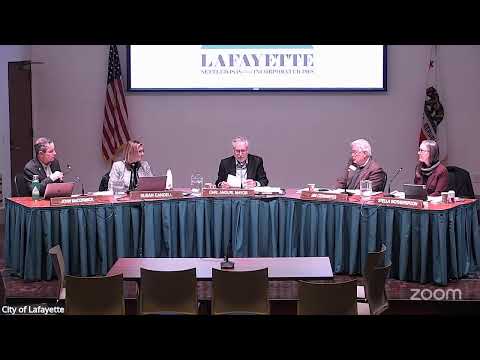
Lafayette council authorizes mayor to object to Plan Bay Area 2050+ over projections and evacuation gaps
Loading...
Summary
The Lafayette City Council voted Dec. 8 to authorize the mayor to send a focused letter to ABAG and MTC raising concerns about Plan Bay Area 2050+ population projections, the plan’s methodology, and missing evacuation‑route analysis, attaching Cupertino’s critique and urging clearer justification for divergence from Department of Finance figures.
Mayor Carl Anduri and the council authorized sending a letter to the Association of Bay Area Governments (ABAG) and the Metropolitan Transportation Commission (MTC) calling for clearer methodology and targeted fixes in the draft Plan Bay Area (PBA) 2050+.
Council members and staff said the decision followed public comment from local students and residents who questioned the plan’s population and housing assumptions. City staff and the legislation subcommittee recommended forwarding comments from the city’s staff report and attaching the city of Cupertino’s detailed critique. The recommendation specifically flags differences between the PBA draft population projections and the California Department of Finance Demographic Research Unit (DRU) numbers and asks ABAG/MTC to explain the divergence.
The council’s letter will also press the regional agencies to address public‑safety concerns: several council members noted the draft plan does not meaningfully analyze wildfire evacuation impacts or how increased development could affect evacuation routes. Councilmember discussion repeatedly emphasized that the letter should be short, focused and factual to increase its effectiveness.
Public comment influenced the discussion. Elias Fratwell, a high‑school senior, told the council that the EIR’s population assumptions differ substantially from DRU projections and cautioned against using a single metric to dismiss the plan’s other programmatic goals. Andrew Zheng, another local student, described his family’s experience finding affordable housing and urged the council to weigh the plan’s potential effects on local affordability.
Councilmembers moved to authorize the mayor to transmit a concise letter outlining four primary concerns: (1) request for a clear methodology explaining why DRU figures were not used, (2) questions about population and housing assumptions used in the draft EIR, (3) the absence of adequate wildfire evacuation analysis, and (4) concurrence with Cupertino’s technical comments as an attachment. The motion passed by voice vote.
Next steps: staff will finalize the letter in coordination with the legislation committee and circulate it to neighboring jurisdictions with BART stations and other stakeholders before submission.