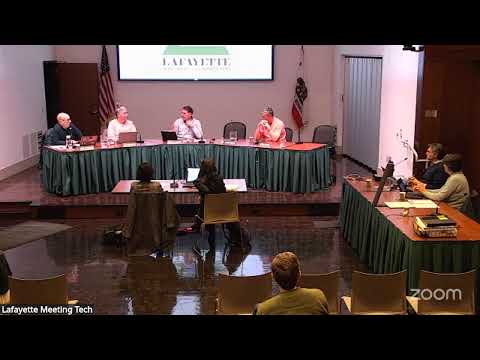
Lafayette planning commission backs revisions to objective design standards, directs staff to add pitched‑roof and imagery changes
Loading...
Summary
The Planning Commission reviewed draft phase‑2 objective design standards for multifamily and mixed‑use development, heard public criticism that the draft does not protect Lafayette’s "semi‑rural" character, and voted 4–0 to send staff‑requested revisions (graphics and pitched‑roof/height language) to city council with a recommendation of approval.
The Lafayette Planning Commission voted 4–0 to direct staff to update the city’s draft phase‑2 objective design standards (ODS) and forward the revised document to city council with a recommendation of approval after a two‑hour public hearing and discussion.
Senior Planner Arleigh Cassidy opened the hearing by saying the ODS are intended to provide objective, ministerial design rules that streamline review of multifamily and mixed‑use projects under state law (SB 35). "The intent of creating objective standards is that they are very hard and fast," Cassidy said, explaining the standards are meant to be answered "yes or no" so applicants and staff reach consistent determinations.
Consultants Monica Sidlick and Cal Kurtz of Lisa Wise Consulting briefly recapped work done over the past year — including rezoning tied to the housing element, DRC working‑group meetings and an open house — and summarized the draft standards covering massing, vertical and horizontal articulation, fenestration thresholds, permitted materials and palette, and site design elements such as parking screening and connections to creeks and trails.
During public comment longtime Lafayette resident Elliot Hudson urged commissioners to reject the draft as written, arguing the illustrations and many of the examples skew toward "modern, blocky" forms that do not reflect the city’s 2022 mission statement goal for a "small‑town, semi‑rural ambiance." Hudson criticized flat roofs and extensive glass as inconsistent with that aim: "This draft allows almost every modern stumpy building you will see that's been put up in the last 10 years," he said, urging the commission to require or strongly prefer pitched roofs and different imagery in the ODS boards.
Commissioners and staff explored whether pitched roofs and a more rural‑feeling exterior could be achieved while meeting the housing element's required densities. Hudson and commissioners noted local examples (Town Center and Byron Park projects) that show pitched roofs and massing strategies can be combined with larger building volumes. Staff recommended adding an ODS‑specific definition of height so that a pitched roof or rooftop amenity would not be counted against the building height limit when it is not conditioned living area; as staff explained, "the height would then be measured to the eave line of the roof," allowing pitched forms without increasing the measurable height of the primary building volume.
Consultants and staff also defended several draft limits intended to preserve material quality and variety; for example, the draft limits certain inexpensive cladding so that no one material (for instance, stucco) dominates a façade. They said some numeric thresholds (fenestration percentages, material caps) were derived from tests against recent and proposed projects and from developer outreach conducted by the DRC subcommittee.
After discussion commissioners agreed on two principal edits to carry forward: revise the appended presentation boards and images to include examples more consistent with a pitched‑roof, semi‑rural sensibility (staff said photos such as Byron Park and Town Center Phase 3 could be inserted), and add ODS‑specific height‑measurement language so pitched roofs and rooftop open space would not automatically count against a building’s height. Commissioners said those changes should remain options rather than mandatory requirements; several voiced concern that prescriptive mandates might make required densities infeasible.
Commissioner DiGiorgio moved to ask staff to update the ODS as discussed — including graphics and the pitched‑roof/height treatment — and forward the draft to city council with a recommendation of approval. The motion was seconded and passed by roll call, 4–0 (Commissioners Mason, DiGiorgio, Radnich and Chair LaBonge voted aye). The item is tentatively scheduled for city council consideration in January.
The commission also directed staff to refine application materials (an objective checklist form rather than a points system) and confirmed the ODS may be revised in the future without waiting for the housing element cycle. Staff reminded the commission there are two planning commission vacancies and noted upcoming state building‑code changes that staff will brief to the commission next year.
The hearing closed with the unanimous decision to forward the updated draft ODS — and the record of public comment and commissioner direction — to the council for the next step in formal adoption.