Get Full Government Meeting Transcripts, Videos, & Alerts Forever!
Get email alerts on the Land Use Lotline Variance topic
No spam. Unsubscribe anytime.
Lafayette commission approves lot‑line revision and variance for Spring Hill Lane property over neighbor objections
Summary
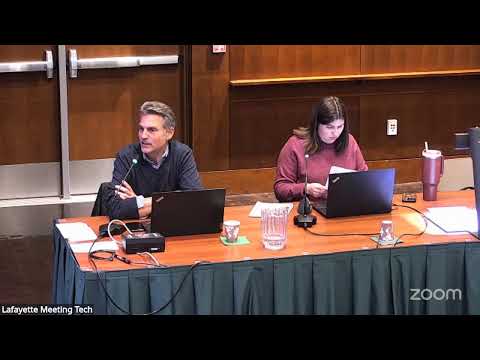
After extended public comment alleging staff cover‑ups, the Lafayette Planning Commission voted 4–1 to approve a lot‑line adjustment and variance for properties at 19–20 Spring Hill Lane, adopting Resolution 2025‑20 and announcing a 14‑day appeal period.
The Lafayette Planning Commission voted to approve a variance and lot‑line adjustment affecting 19 and 20 Spring Hill Lane, adopting Resolution 2025‑20 and finding the project exempt from CEQA. The measure passed 4–1 after neighbors raised allegations of unpermitted construction and criticized staff handling of the case.
Neighbor Debbie Lindes, who said she lives immediately east and north of the project, urged the commission to investigate city staff conduct and described the application as "an effort by the applicants actively abetted by city staff to retroactively whitewash illegal construction inside the setback immediately adjacent to my family's home." She pointed commissioners to prior complaints and litigation from April and July 2024 as context for her concerns.
An adjacent neighbor, Michael Hoffman, told the commission he believes the lot‑line revision attempts to circumvent prior conditions of approval and argued only the commission can authorize the change. Staff responded that the lot‑line adjustment would bring the smaller parcel into conformance with LR‑5 district minimum lot size (5 acres) and that the revision could remedy the setback nonconformity created when a replacement dwelling was moved closer to the property line.
The commission discussed whether previously approved plans impose binding, unchangeable conditions and whether the current application creates or remedies a nonconforming situation. Several commissioners emphasized their role is to evaluate the findings in the staff report, not to adjudicate private litigation.
A motion to adopt Resolution 2025‑20 — approving the variance and lot‑line adjustment subject to standard conditions and finding the project exempt from CEQA — passed by roll call: Commissioner Mason — Aye; Commissioner DiGiorgio — No; Commissioner Radnich — Aye; Vice Chair Deming — Aye; Chair LaBonge — Aye. The commission announced a 14‑day appeal period.
The applicant told commissioners the goal was to "bring the parcel into compliance for the LR‑5" and that the lot‑line adjustment was meant to meet setback criteria. City staff reiterated that the revision is intended to remedy substandard aspects of the existing development and that, with city attorney review and project conditions, staff did not identify a legal basis to deny an owner remedying nonconformities.
Next steps: the decision is final unless appealed within 14 days, after which the matter could proceed to review by the courts if challenged privately.