
Parents and students press King George school board over middle-school club policy after GSA request
Get AI-powered insights, summaries, and transcripts
Subscribe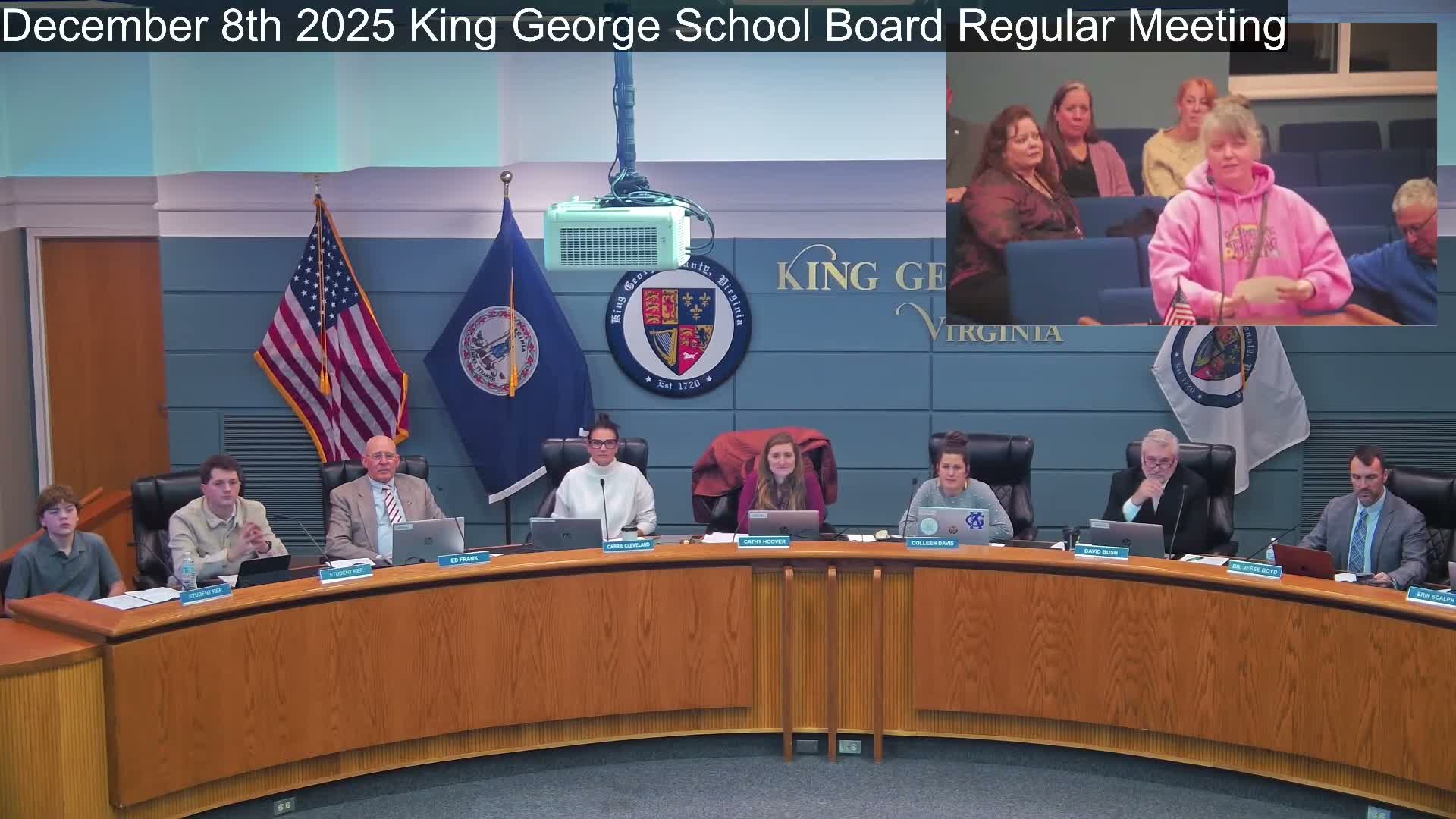
Summary
Students and parents told the King George County School Board that canceling nonacademic clubs at the middle school — including a requested GSA — denies safe peer support; the board said the district has not had nonacademic middle-school clubs for nine years and will continue community conversations.
Several students and parents used the board’s public-comment period to criticize district handling of a student’s request to form a Gender-Sexuality Alliance at King George Middle School and to press the board for clearer, consistent rules on middle-school clubs.
Theresa Cato, who identified herself as a resident of the Shiloh District, said the decision to stop allowing clubs at the middle school because of public reaction to one group was “shameful.” She framed clubs as part of what the division’s mission calls for — to “empower, engage, inspire” students — and told the board those out-of-classroom connections had been “vital” in the education of her children.
Student Zoe Jean Wheeler, who said she sought to form the GSA, told the board the club was meant to “help people, to make people feel more safe in your school.” She pushed back against accusations aimed at a proposed teacher sponsor, saying the club followed the district’s rules and was intended as a peer support space: “It’s just for people to connect and feel, be together and help people.”
Parent John Wheeler said he supported a supervised, adult-led space for students who are questioning or struggling. “I’d rather they be supervised by an adult we trust than to scour the shady corners of the Internet,” he said, arguing the club was a safer alternative to unsupervised online forums.
Superintendent Dr. Boyd responded in the meeting’s question-and-answer period by clarifying the district’s current practice. “Just to clarify, we do have clubs at the middle school. We have academic clubs. We just have no nonacademic clubs, and we haven’t had any nonacademic clubs at the middle school for nine years,” Dr. Boyd said, adding that administrators considered a range of factors — including staffing and space — when evaluating club requests.
Board members thanked commenters for coming forward and said the board would continue to hear community feedback. No formal action was taken on club policy at the meeting; the item remained in the discussion and public-comment phase.
Next steps: the board signaled it would continue outreach and follow-up with stakeholders before considering any change in practice or formal policy action.