Get Full Government Meeting Transcripts, Videos, & Alerts Forever!
Get email alerts on the Fire Staffing topic
No spam. Unsubscribe anytime.
Consultants praise High Point—s ISO Class 1 rating, urge staffing and training changes after incident review
Summary
A third-party review presented at a manager—s briefing found High Point Fire Department performed well in a recent Barbee Avenue incident but recommended more staffing, multi-company training, improved incident command and capital investments; the city also recently won a SAFER grant for 24 firefighters.
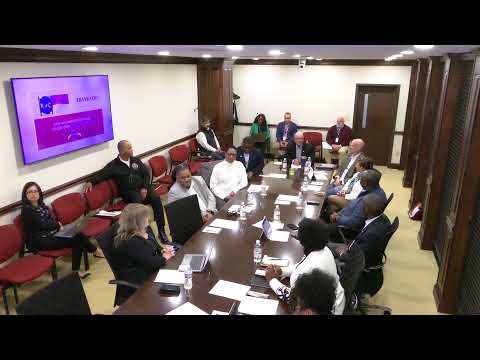
A consultant presented a third-party review of the High Point Fire Department during a manager—s briefing, saying the department is accredited as an ISO Class 1 agency and was awarded a SAFER grant that will add 24 firefighters. The report concluded the department—s initial response times are strong but recommended staffing increases, training changes and operational improvements to reduce risk on complex incidents.
The presenter said the review combined an on-site post-incident analysis of an April Barbee Avenue call with six years of local incident data and benchmarking against similar North Carolina cities. "You were fortunate enough to receive a 2024 SAFER grant for 24 additional firefighters," the presenter said, calling the award "tremendous" and central to recommended next steps.
Why it matters: the report found High Point—s 90th-percentile time for the first responding unit is about 6 minutes, 30 seconds—consistent with industry benchmarks—while the 90th-percentile time to assemble a full complement for a structure fire was about 10 minutes, 19 seconds, leaving a gap the consultants said staffing changes could narrow. "To get the necessary number of people on the fire ground, your time was 10 minutes and 19 seconds or less 90% of the time," the presenter said.
The consultants highlighted three priority areas. First, staffing: operating many companies with three firefighters delays the ability to meet the federal "two-in/two-out" requirement and slows arrival of a full complement. The presenter explained the legal safety requirement: "You have to assemble at least 4 people before you go in make an interior attack," and said adding staff so companies routinely arrive with four people would reduce the time crews must wait to make interior entry.
Second, training and documentation: the review team audited training records and found the department had met ISO training criteria (the presenter said High Point "earned a class 1 rating and ... 9 of the 9 points in training") but recommended more multi-company exercises, standardized class titles/curricula, and better record compartmentalization so hours can be counted across required categories.
Third, incident command and communications: the consultants said the incident commander on the reviewed call was heavily loaded and that improved command support and air-management training would reduce the risk of entanglements and trapped firefighters on complex scenes.
The briefing covered facility and equipment options: the presenters recommended modernizing the city—s training center, citing containerized "ConEx" live-fire training modules used by neighboring jurisdictions as a cost-effective option that can provide realistic exercises and ISO credit when located in-jurisdiction.
Council members asked several clarifying questions. One asked whether NFPA 1710 is a legal requirement or a best practice; the presenter said NFPA is an industry best practice while OSHA contains enforceable worker-safety requirements such as the two-in/two-out rule and its documentation exception for known rescues. Council discussion also emphasized that the SAFER grant is strictly for staffing, runs three years, and that the city will need to plan to absorb recurring costs at the grant—s end: "It's a 3 year grant," a council member said, and the presenter noted the city may need to budget roughly $5,000,000 to sustain positions after the grant ends.
The report included station-location recommendations: consultants recommended prioritizing where to place the additional SAFER-funded personnel rather than immediately putting four on every apparatus, and suggested that a station-location analysis inform future capital investments.
Following the briefing and questions, a motion to adjourn the manager—s briefing was made, seconded and announced as carried. The council did not take separate votes on policy changes during the session; the immediate next steps are for staff to implement the SAFER hiring and return data on performance changes after those staff are in service.
Quotes in this article are taken directly from the briefing transcript and are attributed to speakers as labeled in the meeting record.