
Cleveland workshop reviews draft impact-fee study proposing $3,505 per single-family-equivalent unit
Get AI-powered insights, summaries, and transcripts
Subscribe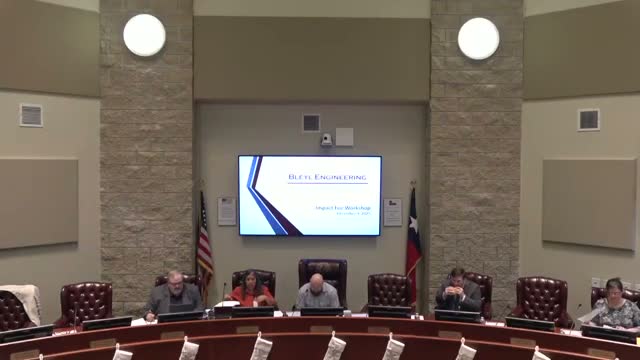
Summary
Consultant Blau Engineering presented a draft impact-fee study that would set a combined water and wastewater fee of $3,505 per single-family-equivalent unit, based on a 10-year CIP of roughly $50 million; council members heard required next steps including public hearings and ordinance adoption but took no action at the workshop.
Blake Behringer of Blau Engineering told the Cleveland City Council workshop that the firm’s draft impact-fee study would levy a combined water and wastewater impact fee of $3,505 per single-family-equivalent unit, with $1,919 allocated to water and $1,586 to sewer. "The impact fee for water, we've calculated to be $1,919," Behringer said.
The consultant said those fees derive from a capital improvements plan of roughly "a little over $50,000,000" in projects over the next 10 years and a land-use-assumptions map that projects where residential, commercial and industrial growth will occur. The draft applies a 50 percent credit in its computations and converts nonresidential water demand to equivalent service units using meter-size and demand formulas.
Behringer gave a nonresidential example to illustrate the methodology: a developer requiring a 6-inch meter could equal about 80 equivalent units, producing an impact-fee obligation in the neighborhood of $280,000 under the draft calculations. He also compared Cleveland’s draft fees to published fees in nearby communities and said Cleveland’s proposed fee remains comparatively low.
The presentation included procedural steps the council must follow to adopt an impact fee. Behringer said the city must publish notices and hold public hearings for the land-use-assumptions map and the CIP, adopt those by ordinance or resolution within 30 days of the hearing, then hold separate public hearing(s) for the impact fee itself and adopt an impact-fee ordinance. He added that, under the draft rules, fees could not be collected earlier than one year after formal adoption.
On program administration, Behringer said impact-fee revenues must be deposited in a restricted fund, spent only on CIP projects listed in the study, and expended within 10 years of collection. He noted the study is subject to mandatory review every five years and that the city must prepare annual reports documenting collections, projects, refunds and credits to support audits.
Behringer also described enforcement options and negotiating pathways: the city could allow developers to build needed infrastructure in lieu of paying fees (potential fee waiver), but such arrangements would be evaluated case-by-case and generally would not be reimbursed from the impact-fee account. The consultant recommended a standing committee of developers, real-estate professionals and staff to monitor updates.
Council members asked whether neighboring jurisdictions impose fees; Behringer and staff noted several nearby cities and municipal utility districts do, and a staff check identified Dayton as charging an impact fee. Sean, a member of the development committee, said developers have already been asking about the city’s timeline for implementing impact fees and are planning accordingly.
The workshop did not include any formal votes. Behringer said staff expects to return with the land-use-assumptions map and CIP after public hearings and that, if the process goes as projected, the city could consider implementing the fee program in the months following those hearings. The workshop adjourned into the regular council meeting with no ordinance action taken.