
McFarland board hears enrollment dip, open‑enrollment gains and shortfall in special‑education funding
Get AI-powered insights, summaries, and transcripts
Subscribe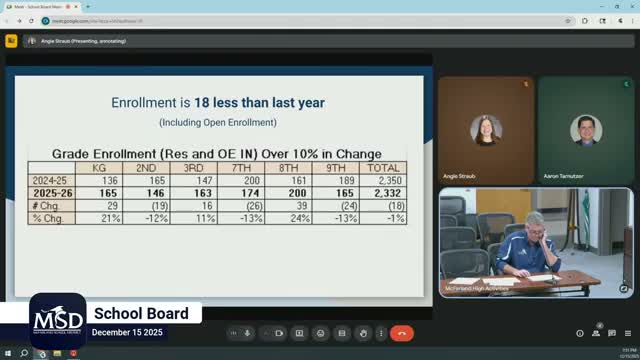
Summary
District staff reported a small resident enrollment decline offset by 158 in‑district open‑enrollment students, producing a net transfer gain of about $980,000; the board was also told state special‑education reimbursement is arriving at roughly 35% rather than the 42% budgeted, increasing pressure on local general funds.
Board members were presented with the district’s enrollment snapshot and projections and were briefed on legislative changes affecting special‑education funding.
Business staff said the third‑Friday count shows total enrollment modestly down year‑over‑year and that the district currently has 158 students open‑enrolling into McFarland and 61 residents open‑enrolling out. That movement created an estimated net transfer revenue gain of about $980,000, staff said. "So what you're talking about for us is a net gain of about $980,000 as a result of 158 in and 61 out," staff said during the presentation.
Administrators reviewed projected counts for the 2026–27 year and noted that without new open‑enrollment inflows the district’s resident population would fall by several hundred students over the coming years. Staff outlined the Jan. 12 board action on open‑enrollment availability, listing proposed available slots by grade (for example, 27 4K slots, 11 kindergarten slots and limited seats at some elementary grades; middle school slots were shown as unavailable in the current plan).
The board’s temporary legislative liaison also summarized biennial budget impacts on special education. She said state budgeting originally projected a 42% reimbursement rate; the actual reimbursement arriving to districts is closer to 35%. "So the actual reimbursement is coming in at 35%," she said, adding that lower reimbursement forces districts to use more general‑fund dollars to meet legally required services.
Board members discussed policy options, the demographic drivers for enrollment (lower birth rates, educational alternatives, and housing availability), and the potential effects of state proposals that would incentivize district consolidation. Several trustees urged community outreach to legislators to address the reimbursement gap; one trustee noted consolidation incentives disproportionately affect rural districts.
Administrators also described the open‑enrollment rules: regular window Feb. 1–Apr. 30, alternative open‑enrollment categories and limited grounds for denial (space availability, expulsion, habitual truancy, incomplete/ineligible applications). Staff emphasized that certain grade levels (notably 4K and kindergarten) historically attract the most new open‑enrollment applicants.
Staff said they will bring the formal open‑enrollment availability list to the board on Jan. 12 for adoption.