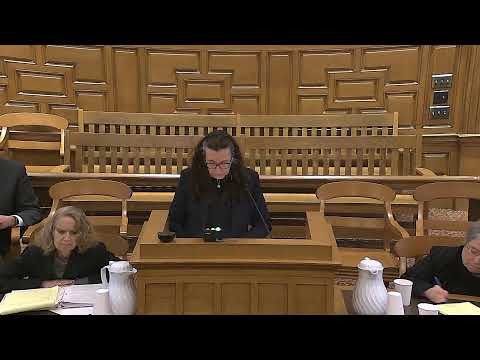
Appeals court hears challenge to voluntariness of Kevin Stacy’s statements
Loading...
Summary
A three-justice panel heard arguments over whether statements by Kevin Stacy were voluntary and whether a trial judge applied the correct legal standard; the Commonwealth urged harmless-error review and the court took the case under advisement.
Chief Justice Amy Blake presided on a three-justice panel that on the morning call considered an appeal in Commonwealth v. Kevin Stacy (docket 24P1123). Appellant counsel Brett Bobean argued the motion judge applied the wrong standard and urged the panel to decide voluntariness as a question of law on the record. Bobean stressed that his client was intermittently "on the nod" during questioning and argued the presence of a trooper’s testimonial claim about fentanyl may have carried a stigma that prejudiced the jury.
The dispute centered on two linked issues: whether the motion judge’s written findings provided an adequate factual basis for this court to apply the proper voluntariness standard, and whether any error was prejudicial. Bobean told the panel that "when someone has the ability to... invoke their rights," that capacity is highly probative of voluntariness; he argued that episodic unconsciousness while statements were being obtained makes this case distinguishable from prior decisions such as Liptak and Brown.
Assistant District Attorney Krista Elliott responded that the record shows the defendant was able to respond coherently to on-scene inquiries and that the trial judge credited relevant testimony. Elliott argued the totality of the circumstances supports a conclusion that the statements were "free and voluntary," and urged the panel to find any omission harmless given unchallenged medical admissions, trooper observations, and the severity of the crash. "All of the defendant's statements were very clearly free and voluntary," she told the court.
Justices pressed both sides on whether remand would be necessary if the panel found the judge applied the wrong standard, and on what showing of prejudice the Commonwealth must make. The court did not rule from the bench; it stated the case was under advisement.