
Madison County supervisors press Rapidan Service Authority for clearer water, sewer policies
Get AI-powered insights, summaries, and transcripts
Subscribe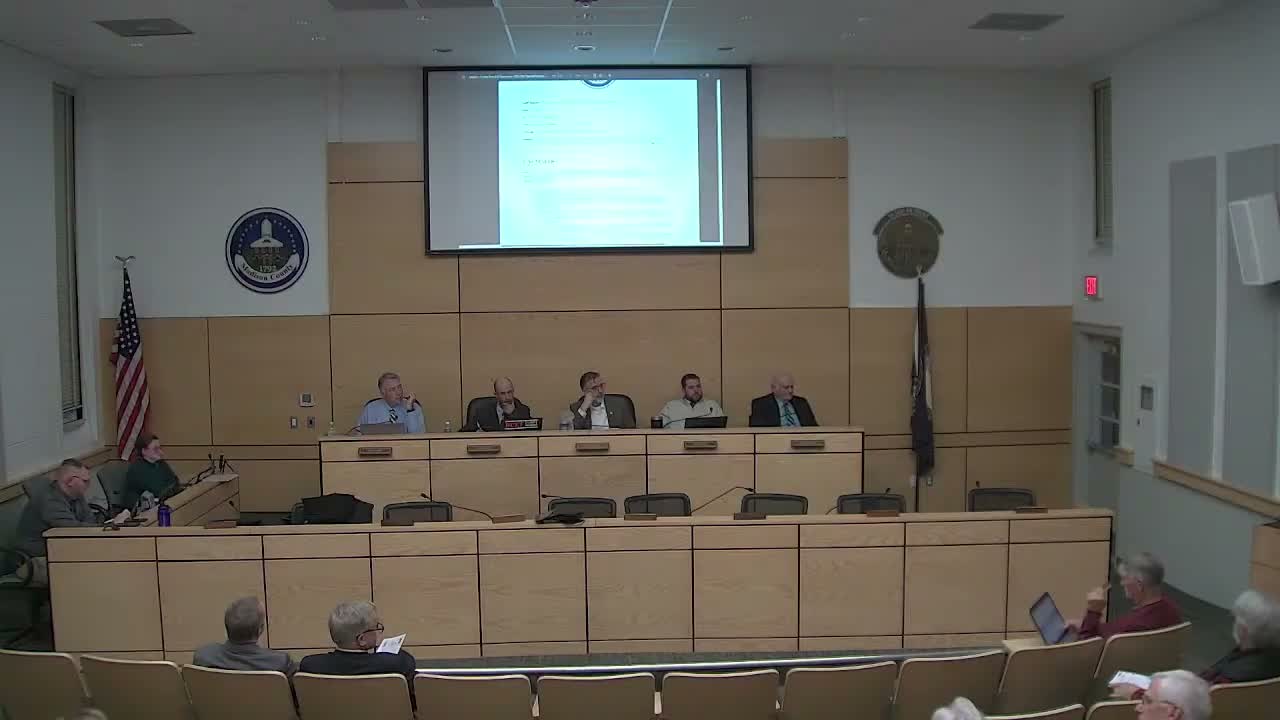
Summary
County staff told supervisors that gaps in RSA data, hydraulic models and EDU rules risk hampering growth and public health; supervisors agreed to a small working meeting with RSA to clarify capacity, EDU allocation and an expansion outfall before formal direction.
Madison County supervisors on Dec. 9 pressed the Rapidan Service Authority to clarify who may connect to the countysystem and how water and sewer capacity will be allocated as RSA plans a sewer-plant expansion.
County staff member Miss Nichols told the board the county lacks published service-area boundaries, up-to-date hydraulic models and a transparent EDU (equivalent dwelling unit) acquisition and reserve policy. "Without clarity on service area system capacity or EDU allocation practices, neither the County nor our residents can plan with confidence," Nichols said, arguing those gaps could cause missed economic opportunities and public-health risks in areas with aging septic systems.
Board members raised immediate concerns about how many EDUs the expanded plant will produce; estimates cited in the discussion ranged from roughly 350 to more than 600 EDUs depending on the source. Supervisor (unnamed in transcript) said he had counted potential units under existing zoning and warned that absorbing hundreds of EDUs without a reserve policy could "set the county back 50 years in economic development" by leaving insufficient capacity to support town redevelopment and corridor businesses.
Representatives of RSA responded they are ready to meet and work through the issues. RSA leadership emphasized that, under current practice, "we do not sell EDUs until the county has approved a project," and that the authority is seeking a funding mix of grants plus EDU sales so that existing customers do not bear the full cost of growth. RSA members also said they have been working on the sewer-plant project for several years and have some grant funding in hand.
The board and RSA agreed on an early next step: a small working group of county supervisors, county staff and RSA representatives will meet informally to collate outstanding questions, identify what documents exist, and seek clarity on EDU counts, hydraulic capacity and potential outfall locations before the board issues formal directions. Miss Nichols also said a FOIA request for RSA documents remains pending and RSA has used the statutory extension period to respond.
The board did not adopt formal policy changes at the meeting; instead it directed staff to coordinate a meeting with RSA and report back to the Board in the coming weeks. The board emphasized that any policy or connection-standard changes should be driven by engineering analysis, published service boundaries and transparent EDU rules so that future development and public health needs can be addressed predictably.