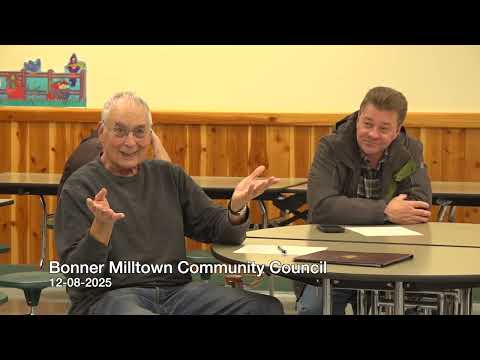
Bonner Milltown Council weighs Blackfoot Crossing plan; residents demand affordability metrics, oppose travel plaza
Loading...
Summary
At a Dec. 8 meeting, Bonner Milltown Community Council discussed the Blackfoot Crossing development application and asked the developer and county for clearer affordability metrics, a deed restriction to cap density, and stronger protections on water/wastewater; many residents voiced opposition to a proposed travel plaza.
Bonner Milltown — The Bonner Milltown Community Council spent its Dec. 8 meeting focused on the Blackfoot Crossing development application, pressing the developer and county staff for measurable commitments on attainable housing, deeded caps on density and clarity about water and wastewater approvals while many residents voiced strong opposition to a proposed travel plaza.
Council members and residents said they support the stated goal of bringing more housing to the area but want concrete metrics that define what the developer means by “attainable” or “affordable.” Greg, the property owner and project applicant, told the meeting that the project “will be as affordable as I physically can” and said the team plans to use standard affordability metrics such as area median income (AMI) and to partner with community land trusts and Habitat for Humanity. He said county staff are involved in shaping requirements tied to targeted economic-development funding.
Residents repeatedly asked for a clear affordability target they can point to in a letter to county decision-makers. One participant urged the council to “trust, but verify,” suggesting the letter request a specific AMI percentage or a fixed number of units to be held affordable.
Water, wastewater and wells were another central topic. The developer said the plan calls for two drilled wells for redundancy and that state approvals — including an aquifer (72-hour) pump test and Department of Environmental Quality (DEQ) signoffs — are prerequisites for approvals. The developer told the council that “DEQ will not approve our wastewater system if we don't meet their requirements,” and county staff and residents emphasized that a failed aquifer test would effectively stop the project until technical issues are resolved.
Density and enforceability of limits were also discussed at length. Council members and residents pressed the developer to record deed restrictions or covenants that would travel with the land; Greg said the application already includes proposed covenant language and that deed restrictions can be recorded with the property. The council discussed a working cap of 400 total dwelling units (roughly comparable to nearby West Riverside density, which was cited during the meeting) and asked the county attorney about whether such conditions can be made permanent.
The proposed travel plaza on the property emerged as the single most contentious commercial element. Multiple attendees said a travel plaza would not serve neighborhood needs, could harm quality of life by increasing noise and activity, and could foreclose other types of community-serving businesses. The developer and consultants said the travel plaza would occupy only a portion of the community-commercial acreage and would be sited as far from housing as practicable, but residents insisted the council register clear opposition to that use in its letter.
The council agreed on four headline points to include in a draft letter to the county commissioners and planning staff: (1) request measurable affordability commitments (for example, an AMI target or a percent of units reserved at a stated AMI); (2) request a recorded deed restriction capping total units (400 units was discussed as a proposed cap); (3) request that the project’s water and wastewater system remain under the applicant’s ownership and not be compulsory for surrounding properties while allowing voluntary hookup; and (4) state strong community opposition to a travel plaza. The chair said the council will draft the letter, post materials (on Missoula Voice or via a shared Dropbox link), and hold a special public meeting (with the required 72-hour notice) to finalize the letter before the planning board and county deadlines.
Other business: the council approved routine agenda and minute items, temporarily seated alternate Jessica Gledkey to participate on the Blackfoot Crossing discussion while a member recused, and scheduled follow-ups on a West Riverside Park support letter and an annual picnic. The council set the next regular meeting for Jan. 12, 2026.
What’s next: The council will circulate a draft community letter for comment and hold a special meeting to consider edits. County staff and the developer will provide the outstanding application materials and the results of required technical studies (aquifer pump tests, wastewater design reports) as they become available.