Get Full Government Meeting Transcripts, Videos, & Alerts Forever!
Get email alerts on the Housing And Zoning topic
No spam. Unsubscribe anytime.
Council holds first reading of zoning text and map changes to implement Fortuna's sixth-cycle housing element
Summary
The council held first readings of two ordinances to amend zoning text and adopt a qualified combining zone to implement the sixth-cycle housing element and the Mill District specific plan; staff emphasized state housing-law compliance and outlined where multifamily development with 20% affordable units would be permitted by right.
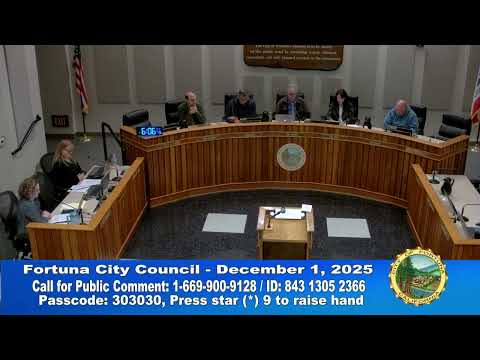
The Fortuna City Council on Dec. 1 held first readings for two related ordinances to implement the city's sixth-cycle housing element and to update zoning maps for the Mill District specific plan.
Michelle Nielsen, contract city planner with Plan West, presented the staff report and slides. She said the package includes two sets of changes: (1) zoning text amendments to align Title 17 with the general plan and state housing law, including adding definitions and explicitly allowing supportive housing, transitional housing and community care facilities for six or fewer individuals consistent with state law; and (2) zoning map amendments to adopt or replace qualified combining zones (Q zones) in several areas so multifamily development is permitted by right where at least 20% of units are set aside as affordable to lower-income households.
Nielsen explained the state-law context and programmatic drivers: "State law requires a city's zoning ordinance and other land use regulations to be consistent with the general plan," she said, and noted the housing element programs and the Mill District specific plan changes that triggered updates. She described that the Q zone approach seeks to preserve existing single-family residences in adjacent neighborhoods while making multifamily feasible on inventory sites by right when affordability thresholds are met. Nielsen also described CEQA determinations and statutory exemptions that staff believes apply.
Council members pressed staff on policy choices. One member asked why multifamily would not simply be allowed by right; Nielsen said feedback from housing analysts and HCD indicates that making multifamily permissive by right can reduce incentives to deliver the 20% affordability target and that conditional approaches may help preserve incentives while complying with state requirements. On how affordability is calculated, Nielsen said affordability is measured against area median income (AMI) published by the state and adjusted by household size; she noted that 80% and below of AMI is typically treated as lower income under state definitions.
Council closed the public hearing with no public speakers and moved to introduce and hold first reading of both ordinances by title only, continuing the public hearing to the council's next regular meeting for second reading and adoption. Roll-call votes to introduce both ordinances carried unanimously at the meeting.
What happens next: the council will take the second reading and consider formal adoption at a subsequent regular meeting; staff recommended findings of CEQA consistency and identified the specific housing-element programs the amendments implement.