
University of Houston–Sugar Land aims to double enrollment, pursues biotech partner and master developer
Get AI-powered insights, summaries, and transcripts
Subscribe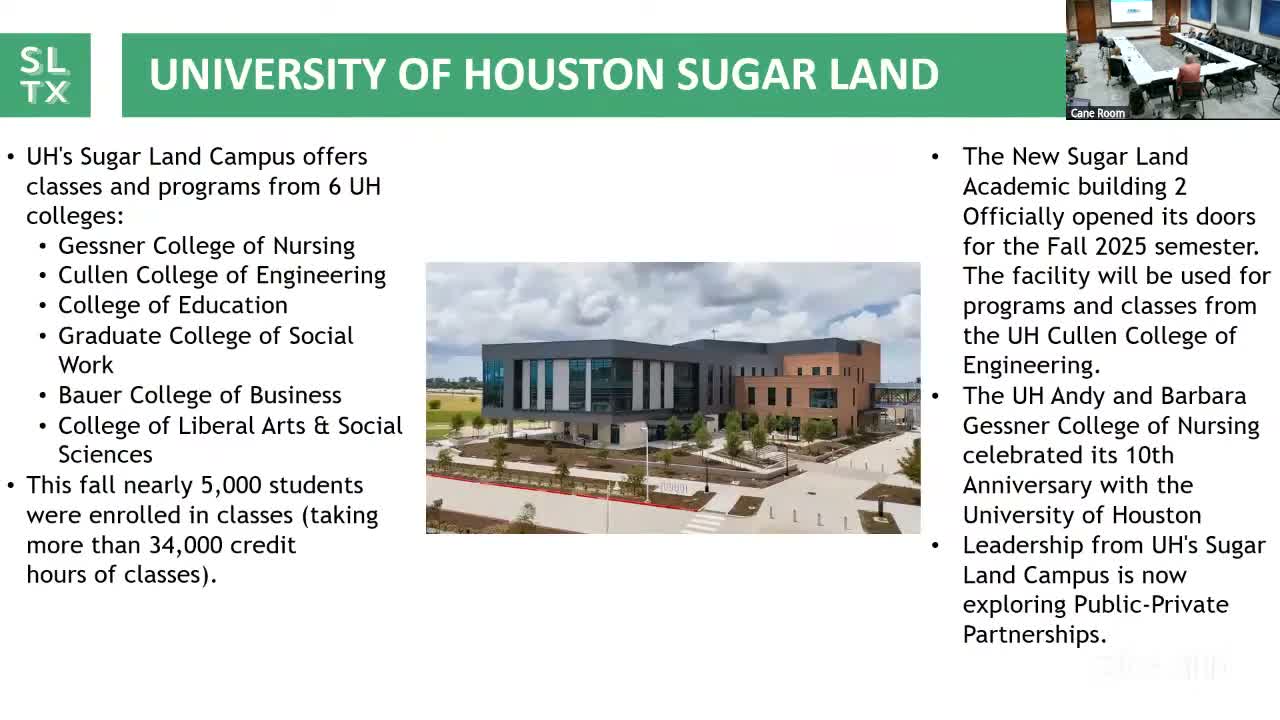
Summary
University of Houston–Sugar Land officials told the TIRZ No. 4 board the campus serves about 5,000 students and has a goal to reach 10,000. The campus is pursuing an RFQ for a master developer and is under an NDA with a biotech firm interested in a 100,000-sq.-ft. facility.
University of Houston–Sugar Land officials told the Tax Increment Reinvestment Zone No. 4 board on Dec. 15 that the campus is expanding academic programming and facilities while pursuing private partners for an industry partnership zone.
Dr. Jay Veil, vice president of academic affairs and chief operations officer for the Katy and Sugar Land campuses, said UH–Sugar Land serves about 5,000 students in the Sugar Land market, excluding an additional 1,600 students enrolled through a partnership with Wharton County Junior College. "My charge from president is to get the campus to 10,000 students," Veil said.
Veil described a recently completed Academic Building No. 2 of about 75,000 square feet that includes an imaging research center, drone laboratories and four active-learning classrooms. He noted the campus has a sky bridge and an adjacent 40-acre industry partnership zone where the university is planning mixed-use collaboration with private partners.
On private development, Veil said the campus is under a nondisclosure agreement with a biotech company interested in a roughly 100,000-square-foot building and that the university has started an RFQ process for a master developer. "We shortlisted 2," he said, and presentations were expected to begin after the meeting break with a goal of naming a developer by March.
Veil said student housing is not yet in place and that university planners prioritize a student center or recreation space before building residential units. He explained that some on-campus food service is limited by capital construction bond rules and current options are largely kiosks or self-service, with student services fees identified as a funding source for a future student center.
Veil highlighted the campus' efforts to attract partners with demonstrated academic purpose—internships, faculty research collaborations and intellectual property—rather than transactions that are purely real estate. He emphasized work with the College of Architecture on master planning and plug-and-play models to help commercialize university research.
The board did not take formal action on the campus presentations; university staff requested continued coordination with the city and TIRZ staff on site planning and infrastructure support.