Get Full Government Meeting Transcripts, Videos, & Alerts Forever!
Get email alerts on the Budget topic
No spam. Unsubscribe anytime.
Troy officials outline 2026 budget, warn county action on MCD assessment could shrink fund balance
Summary
Director of Public Service & Safety presented the proposed 2026 budget with a $36.2 million CIP, projected flat income-tax revenue (0.4% increase) and near-term capital and paving investments; council set the appropriation ordinance for a later second reading after failing to suspend the rules.
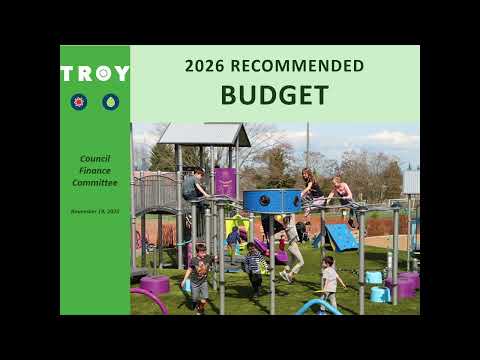
Director of Public Service and Safety Titterington presented the City of Troy’s recommended 2026 budget on Dec. 1, outlining a $36.2 million capital improvement program and projections that show only a 0.4% increase in income-tax revenue over 2025.
Titterington said the city is not proposing new staff positions and highlighted planned capital investments: roughly $1 million in vehicles and equipment across parks, golf course and utilities; about $1.2 million in major paving projects for West Main Street, West Market Street and Experiment Farm; and $1.5 million in local paving. He also told council the draft budget includes $1,000,000 recommended in the parks and recreation capital fund for design and engineering of priority projects.
On fund balance, Titterington warned council of a change at the county level. “There’s some rather creative fiction that’s out on social media right now that we… may have what is perceived as too much fund balance,” he said, adding that a decision by the Miami County Budget Commission to remove the Miami Conservancy District (MCD) assessment from the city’s tax levy certifications could increase the city’s costs. He said the MCD assessment—collected in prior years and subject to a pending rate increase—could add materially to the general fund burden, reducing five-year projected ending balances by about $1.8 million.
The recommended operating budget shows expenses rising about 9.3% and capital costs about 11% over 2025 projections, driven largely by wage inflation, benefits and construction activity, Titterington said. Forecast charts presented at the meeting showed projected ending fund balances falling toward the city’s target levels in later years if the MCD assessment and other pressures hold.
Council did not adopt the appropriation ordinance for 2026 at the meeting. Members attempted to suspend the rules and adopt O33-2025 (the 2026 appropriation) but the suspension failed, so the ordinance was continued to a second reading scheduled by the clerk for Dec. 15.
The presentation and related documents were described as available on the city website and via posted QR codes; Titterington said council would continue to update the five-year forecasts as new information—particularly about the MCD assessment and bond market assumptions—becomes available.