
Volunteers propose Ballinger Park food forest and community garden; council praises concept, asks about costs and maintenance
Get AI-powered insights, summaries, and transcripts
Subscribe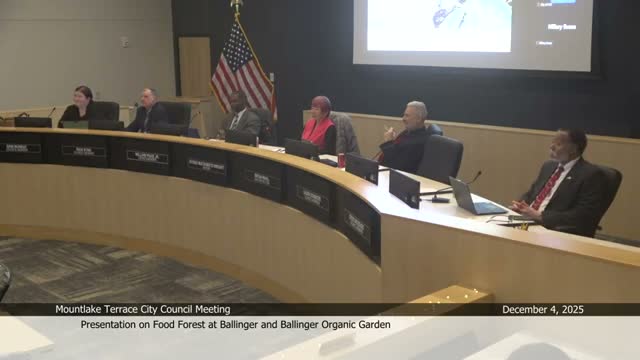
Summary
Volunteer-led Mountlake Terrace Community Foundation presenters proposed a volunteer-run 'food forest' and community garden at Ballinger Park with an estimated startup cost of about $57,700; council members praised the plan and pressed for details on long-term maintenance, soil testing, equitable access and funding.
Presenters from the Mountlake Terrace Community Foundation outlined a volunteer-driven plan for a food forest (FAB) and Ballinger Organic Garden (BOG) at Ballinger Park during the Dec. 3 council meeting.
Recreation and Parks Director Jeff Betts prefaced the presentation with Ballinger Park’s master-plan history and past grant-funded park projects. Robin Rice and Audre Meyer described the food-forest concept — a multilayered, perennial planting approach that mimics natural ecosystems — and said the project would emphasize biodiversity, community education, and open-harvest food security. The presenters said volunteers and partners (including the Ballinger Organic Garden, Edmonds College horticulture instructors and Snohomish Conservation District staff) are already engaged.
The presenters showed a site plan located north of the tee box between an ADA-accessible path and Lakeview Drive. Cost estimates provided to council were approximately $14,000 for the food forest, $29,000 for the community garden (raised beds and soil), and $14,000 for shared community amenities (shed, benches, picnic tables), for a combined startup estimate of about $57,700. Presenters contrasted that figure with a 2015 master-plan estimate of about $230,000 (inflation-adjusted to roughly $315,000) and said the foundation’s itemized approach makes the lower estimate feasible with grants, donations and volunteer labor.
Council members expressed strong support for the concept and raised several questions: long-term maintenance and whether volunteers will sustain the project; options for scholarships or fee waivers to ensure equitable access to garden plots; concerns about proximity to Lakeview Drive and vehicle pollution; soil-testing plans for contaminants; and who would harvest taller canopy trees. Presenters replied they expect volunteers from existing programs (BOG and other local stewardship groups) to support maintenance, that they will pursue grants and donations and that the city could assist with low-cost tasks such as irrigation installation. Presenters also said they will conduct soil testing for contaminants and plan buffers, mounds and a pollinator pathway to reduce exposure near the roadway.
Several council members suggested outreach to culturally specific groups and local institutions to broaden participation, and asked staff to consider how the city could support maintenance or help identify grant opportunities. Presenters announced a volunteer meeting at the Mountlake Terrace Library and invited further community input.
The council took no formal vote on the food-forest presentation; the next steps described were fundraising, volunteer recruitment and coordinating an agreement that clarifies the city’s and volunteers’ roles.