
St. Joseph County Council denies rezoning for proposed data‑center campus after long public hearing
Get AI-powered insights, summaries, and transcripts
Subscribe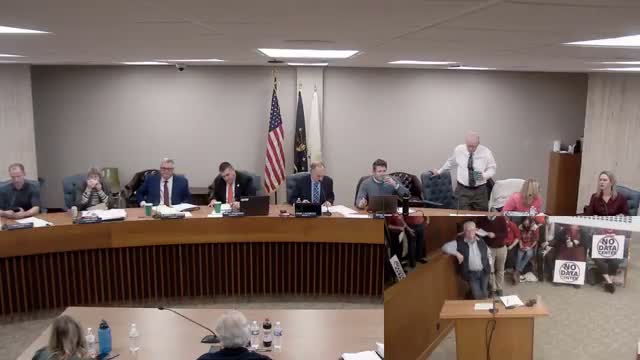
Summary
After more than 10 hours of public testimony, the St. Joseph County Council voted 7–2 to deny a petition (Bill 42‑25) to rezone roughly 1,000 acres near New Carlisle from agricultural to industrial for a proposed data‑center campus; proponents cited jobs and apprenticeships, opponents raised water, traffic, farmland, and comprehensive‑plan concerns.
The St. Joseph County Council voted 7–2 early Sunday to deny a rezoning petition (Bill 42‑25) that would have reclassified about 1,000 acres near New Carlisle from agricultural to industrial to allow a multi‑building data‑center campus.
The decision followed a public hearing opened by President Schaetzel in which more than 100 people spoke during a marathon session that ran into the early morning. Supporters — including union representatives and tradespeople — urged the council to approve the rezoning to create construction work, apprenticeships and longer‑term technician and maintenance jobs. James Gardner of the International Union of Operating Engineers and several other labor leaders said the projects generate training opportunities for local young people and boost local contractors.
Opponents, speaking both in the chamber and remotely, urged council members to respect the New Carlisle town plan and the county comprehensive plan. Molly Hannon, New Carlisle’s representative to the Area Plan Commission, said the Area Plan Commission had forwarded an unfavorable recommendation and warned that converting prime farmland to industrial use would be a ‘‘permanent and irrevocable change.’’ Olive Township trustee Will Miller and New Carlisle Town Council President Marcy Kaufman cited traffic safety near State Road 2 and other local roads, strained emergency services, and increased noise and light pollution.
Many speakers raised environmental and infrastructure concerns tied to large data centers: potential impacts to the Kankakee aquifer, uncertainty about closed‑loop cooling and consumptive water use, and the effect on local electric rates. Multiple residents described day‑to‑day effects they have seen near existing projects — heavy truck traffic, road deterioration and prolonged construction disturbance — and asked the council to ‘‘let the dust settle’’ following Amazon and battery‑plant activity already under way in the county.
The petitioner’s representative, who addressed the council after public comment, said he had provided a written set of commitments and told the council those documents would be recorded as binding. He also agreed during council questioning to add a conditional clause: if the county and petitioner cannot reach an economic development agreement by a specified date, the petitioner would bear the cost to revert the zoning to agricultural. The petitioner’s statement that commitments would be contractual and recordable was repeated during the exchange.
After a period of council debate about the comprehensive plan, public testimony and the petitioner’s voluntary commitments, a motion to deny the rezoning passed on roll call 7–2. The council did not approve the rezoning; members who voted in favor of denial cited consistency with the county and town comprehensive plans and constituent input as key reasons. The meeting moved to miscellaneous business and adjourned.
The county council’s denial halts the immediate rezoning; any future development requiring a different zoning outcome would require a new petition, additional public hearings and another council vote. The petitioner indicated willingness to return with a conditional package should negotiations over a development agreement continue.